May 4, 2026 • Odalys Ferreira • 10 min reading time • Prices verified June 18, 2026
Sloped and Vaulted Ceiling Light Fixtures: What Works When Your Ceiling Isn't Flat
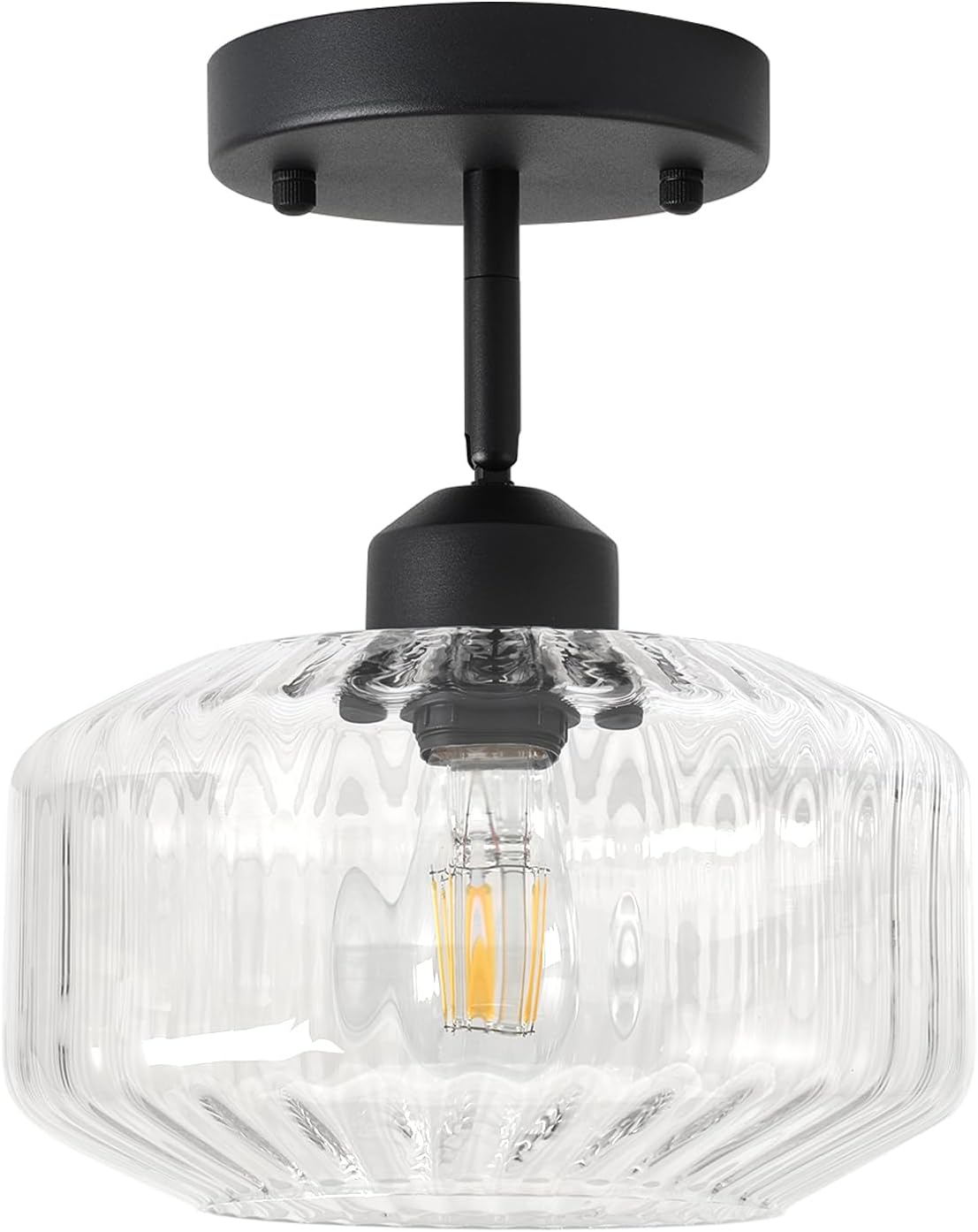
You found the perfect glass pendant — warm-toned seeded glass, aged brass canopy, exactly the scale you sketched out for that dining nook. Then you look up at the ceiling and remember: it’s not flat. It pitches at maybe 30 degrees toward the ridge, and suddenly “will this even work?” replaces “I love this fixture.” That moment of doubt is the starting point for almost every sloped-ceiling lighting mistake, and it almost always costs money.
A sloped ceiling is any ceiling that angles upward rather than running parallel to the floor — this includes cathedral ceilings (the dramatic high peaks you see in open-plan living rooms and A-frames), vaulted ceilings (curved or arched), and the modest pitch you might find over a stairwell or inside a closet. What they all share is this: the standard mounting hardware that ships with nearly every light fixture is designed for a flat, horizontal surface. When you mount that hardware on an angled ceiling, the fixture hangs crooked, the canopy gaps away from the ceiling, or worse — the electrical box connection is compromised. This article walks through what actually works, where the planning failures happen, and how to match the right fixture type to your specific ceiling situation.
Why Sloped Ceilings Break Standard Fixture Hardware
The canopy — that decorative cover that sits flush against the ceiling and hides the electrical box — is the piece most people overlook. A standard canopy is flat-backed, designed to press evenly against a horizontal surface. On a sloped ceiling, a flat-backed canopy creates a visible gap on one side or sits cockeyed, which is both aesthetically wrong and, depending on how it’s mounted, a code concern.
The fix is a sloped ceiling canopy (sometimes called an angled canopy or swivel canopy), which uses a ball-and-socket or pivot mechanism at the junction between the canopy and the mounting hardware. This allows the canopy to sit flush against the angled ceiling while the fixture itself hangs plumb — straight down, perpendicular to the floor, as it should. Per guidance from the Lighting Design Lab’s resources on non-horizontal surface mounting, the canopy-to-ceiling interface is the first variable to confirm before any other spec matters.
The second variable is cord or stem length. This is where the math gets unforgiving. On a vaulted ceiling, the mounting point is higher than it appears when you’re standing in the room — sometimes dramatically so. A cathedral ceiling that peaks at 16 feet at the center means your electrical box might be at 14 or 15 feet at the point where you’re hanging. If a pendant ships with a 5-foot cord and you need 9 feet of drop to reach the right hang height (typically 7 feet of clearance from floor to fixture bottom over a dining table, per Apartment Therapy’s pendant-hanging guidelines), you have a problem that can’t be solved after the fixture arrives.
The Planning Failure Nobody Talks About: Cutting Cord Too Soon
One of the most consistent patterns across owner reviews of pendant lights — across dozens of product listings and style categories — is buyers cutting the cord before testing the final hang. On a flat ceiling, this is a minor inconvenience: you measure, cut, and tuck the excess. On a vaulted ceiling, where the effective drop distance is both greater and harder to eyeball, this mistake is irreversible.
A specific example worth naming: the VILUXY pendant has earned strong praise for its glass quality and overall design, but a recurring one-star-equivalent experience in its review history involves a buyer who loved the fixture and had to return it — not because of a defect, but because the cord wasn’t long enough to reach a usable hang height on a cathedral ceiling. This isn’t a product failure. It’s a planning failure, and the article you’re reading exists partly to prevent it from happening to you.
The rule before you cut any cord:
- Mount the fixture with all cord slack intact.
- Adjust to your intended hang height and mark with tape.
- Live with the excess cord tucked temporarily for at least a day — confirm the height feels right at different times of day and from different positions in the room.
- Only then cut — and leave an extra two inches beyond your mark as a buffer.
This Old House’s installation guidance on sloped-ceiling fixtures echoes this principle: always verify the final hang position in context before any irreversible cut.
Matching Fixture Type to Ceiling Type
Not every fixture type is equally suited to every sloped-ceiling scenario. Here’s how to think about it:
By the numbers: Sloped ceiling compatibility at a glance
| Ceiling Pitch | Flush Mount | Semi-Flush | Pendant (hardwired) | Pendant (plug-in) |
|---|---|---|---|---|
| 0–15° (gentle slope) | Most work with adapter | Most work | Most work | Most work |
| 15–30° (moderate pitch) | Needs sloped adapter | Needs swivel canopy | Confirm cord length | Check strain relief |
| 30–45° (steep/cathedral) | Adapter required; verify rating | Specialty only | Cathedral-rated cord length essential | Often impractical |
| 45°+ (A-frame/extreme) | Purpose-built only | Not recommended | Specialty or surface-wired | Not recommended |
Flush Mounts on Pitched Ceilings
Flush mounts (fixtures that sit very close to the ceiling surface, leaving little or no gap between the fixture body and the ceiling) are the default choice for hallways, closets, and low-ceiling spaces — but they’re also the category most likely to ship with hardware that simply doesn’t accommodate a slope. The TeHenoo sloped ceiling flush mount is notable precisely because it solves this: reviewers consistently call out the included sloped ceiling adapter as the reason they chose it over competitors. For closets and hallways with a pitched ceiling — a use case that most flush mounts simply don’t accommodate — having the adapter in the box removes the guesswork entirely. This is not a universal feature, and its presence here is worth naming explicitly.
For design-forward applications — a pitched-ceiling hallway in a craftsman home, a sloped ceiling over a reading nook — this category is underserved by the market, and finding a flush mount that both looks intentional and includes proper sloped hardware is genuinely difficult. When you find one that does both, it’s worth the premium.
Pendants on Vaulted Ceilings
Pendants are the natural choice for vaulted and cathedral ceilings because the long drop actually works in your favor aesthetically — it brings the light source down to a human scale without fighting the architecture. The challenge is purely mechanical: cord length, canopy compatibility, and hang-height planning.
The Kichler Madden earns specific praise in owner reviews for including multiple hanging-length options and explicit sloped-ceiling compatibility. Owners report that installation was straightforward even in non-standard ceiling configurations — which, in pendant-land, is genuinely uncommon. Most pendants ship with a single cord length and a standard flat canopy, leaving the buyer to source an aftermarket swivel canopy and hope the cord is long enough. A fixture that anticipates the problem in the box saves a trip to the hardware store and reduces the risk of the “cord too short” scenario.
For glass-specific pendants at the design tier — seeded glass, hand-blown, opaline, ribbed — the canopy and cord system is almost always a separate conversation from the glass shade itself. When spec’ing a Visual Comfort or Rejuvenation pendant for a vaulted-ceiling application, confirm with the manufacturer or retailer whether a swivel canopy is available for that specific fixture family. Architectural Digest’s coverage of ceiling-height and lighting scale notes that in rooms with vaulted ceilings above 12 feet, scale compensation (using a larger-diameter shade or a cluster of pendants rather than a single small shade) prevents the fixture from reading as visually lost.
Semi-Flush and Close-to-Ceiling Fixtures
Semi-flush mounts (fixtures with a short stem between the canopy and the shade body, typically 4–12 inches) fall into a middle zone: more adaptable than flush mounts on moderate slopes, but not as cleanly solvable as pendants on steeper pitches. For a 15–25 degree slope, a semi-flush with a swivel canopy is often the cleanest solution — it reads intentional, doesn’t fight the ceiling geometry, and keeps the fixture body below the slope where it can distribute light properly. For steeper pitches, the short stem becomes a liability: the shade body may tilt visibly even when the canopy sits flush.
Houzz community discussions on vaulted ceiling lighting consistently flag this semi-flush geometry issue on steeper slopes, with designers recommending pendant solutions (longer cord, full hang) over semi-flush mounts once ceiling pitch exceeds approximately 30 degrees.
Frequently Asked Questions
How do I know if a pendant light is compatible with a sloped or vaulted ceiling?
Look for explicit mention of a sloped ceiling canopy, swivel canopy, or angled canopy in the product specifications. If the listing only shows a flat-backed canopy, assume it is not compatible without modification. When in doubt, contact the manufacturer before purchasing — most lighting brands can confirm whether a swivel canopy is available for a specific fixture family, and some will ship it as an accessory.
What cord length do I need for a 12-foot cathedral ceiling?
Measure the height of your electrical box from the floor, then subtract your target hang height (typically 7 feet of clearance from floor to fixture bottom for general room pendants; 6.5–7 feet over a dining table). For a 12-foot ceiling with the box at 11.5 feet and a 7-foot target clearance, you need approximately 4.5 feet of drop — but add at least 12 inches of buffer before purchasing, because you can always trim; you cannot add. If your box is at the peak of a steeper vault, recheck the actual measurement rather than estimating from floor plan dimensions.
Can I add a sloped ceiling adapter to a pendant that doesn’t include one?
Yes, in most cases. Universal swivel canopy adapters are available as aftermarket accessories and work with most standard pendant cord sets. The fit depends on the mounting hardware of the specific fixture, so confirm the mounting hole diameter and the canopy diameter before ordering. This Old House notes that universal adapters typically accommodate slopes up to 45 degrees, but you should verify the specific product’s rated angle range.
Is it safe to extend a pendant light cord if it’s too short?
Technically possible, but not recommended as a DIY solution. Extending a pendant cord requires splicing electrical wire inside the cord set, which must be done inside a junction box and meet local electrical code — it is not a simple add-on. If your cord is too short after installation, the correct solution is to contact the manufacturer about a longer replacement cord set, or to source a compatible longer cord from an electrical supplier. Cutting and re-splicing is a licensed-electrician job, not a workaround.
What is the difference between a sloped ceiling canopy and a standard canopy?
A standard canopy has a flat back designed to press flush against a horizontal ceiling. A sloped ceiling canopy uses a ball-and-socket or pivot joint that allows the canopy face to sit flush against the angled ceiling while the mounting hardware remains fixed to the electrical box — letting the fixture hang plumb regardless of the ceiling angle. The pivot joint is the functional difference; everything else is cosmetic.
Should I choose a flush mount or pendant for a steeply vaulted ceiling?
For steep pitches (30 degrees and above), a pendant is almost always the better practical and aesthetic choice. Flush mounts on steep slopes require purpose-built sloped adapters with specific angle ratings, and even with the right hardware, the fixture body can look visually awkward pressed against a sharply angled surface. A pendant naturally compensates for the slope by hanging plumb from whatever height the ceiling provides. Reserve flush mounts for slopes under 20–25 degrees, where the geometry is forgiving enough to look intentional.
The decision rule, plainly: if your ceiling pitch is under 20 degrees, most flush mounts work with an adapter and most pendants work as-is — confirm the canopy type and buy. If your pitch is 20–45 degrees, treat sloped-canopy compatibility as a non-negotiable spec, not a bonus feature, and plan cord length from actual ceiling height measurements before you order. If you’re above 45 degrees, you’re in specialty territory — purpose-built fixtures only, and a conversation with a licensed electrician before you commit to any hardware.