May 4, 2026 • Odalys Ferreira • 9 min reading time • Prices verified June 18, 2026
Seeded and Ribbed Glass Replacement Shades: How to Measure Your Fitter and Stop Buying the Wrong Size
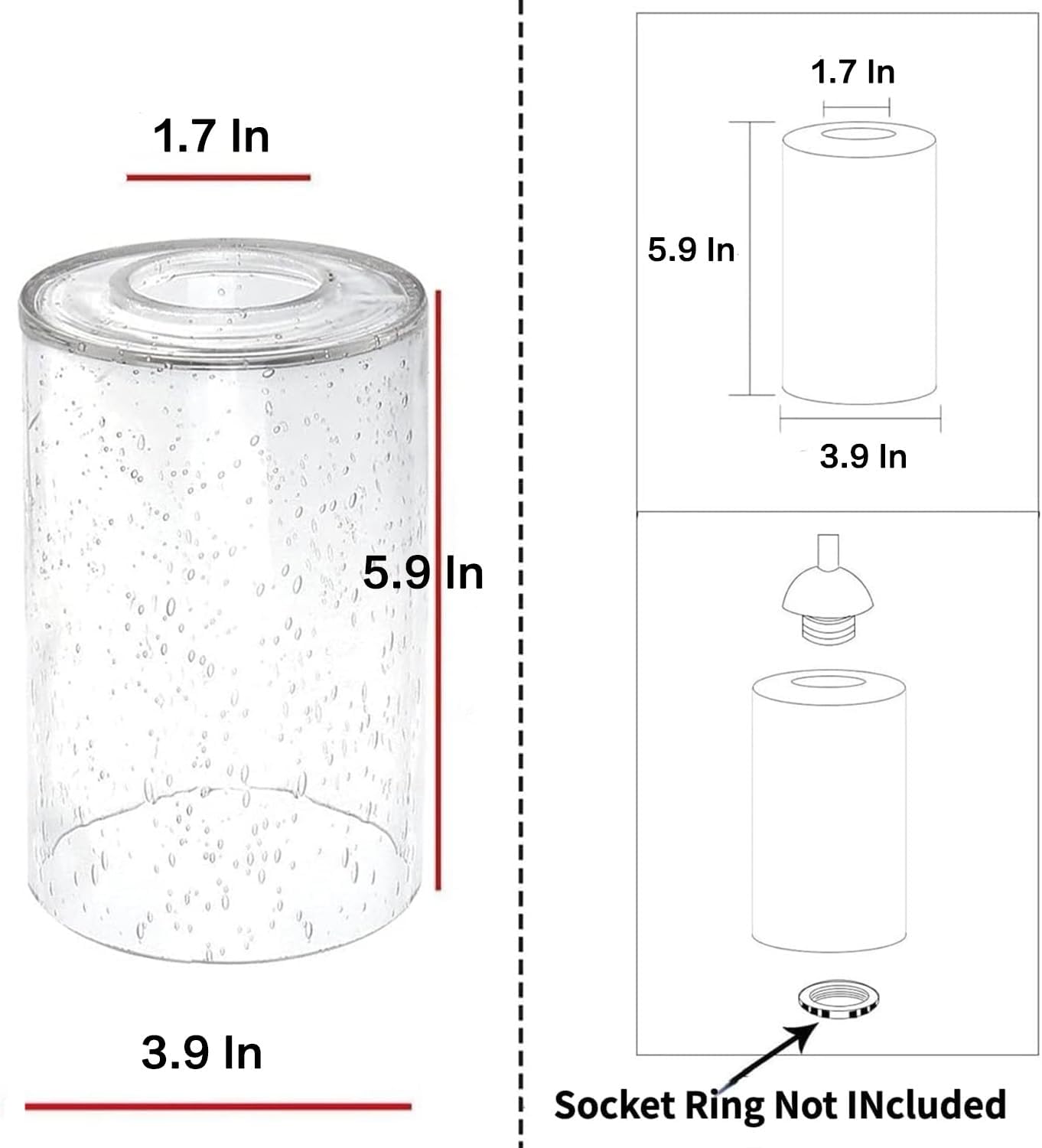
You found the perfect replacement shade — seeded glass with those soft, trapped-air bubbles that scatter light the way you’ve always wanted, or a ribbed cylinder with that satisfying vertical texture. You order it. It arrives. And then you discover the opening at the top of the shade (called the fitter — the rim that locks into or rests on the fixture’s mounting hardware) is either too wide to stay put or too narrow to seat at all. The shade goes back. This happens constantly, and it’s almost entirely avoidable with one careful measurement taken before you start shopping.
This guide is for anyone replacing a glass shade on an existing fixture — whether you’re sourcing a single seeded-glass globe for a 1920s bathroom sconce or speccing six ribbed pendants for a kitchen renovation. By the end, you’ll know how to read your fixture’s fitter type, take the three measurements that actually matter, and make a confident decision between seeded, ribbed, and opaline glass options without guessing.
Why Glass Shade Sizing Trips Up Even Experienced Renovators
The fitter is the attachment point where a shade meets the fixture. It sounds simple, but the industry uses three different fitter standards — and none of them are stamped on the outside of your old shade.
The three fitter types you’ll encounter:
- Slip fitter (most common): The shade’s top opening slips over a hollow tube or “neck” on the fixture and is held in place by a set screw or collar. The shade hangs from the outside of the tube.
- Uno fitter: The shade screws directly onto the lamp socket ring, threading into the socket just as the bulb does. Common on table lamps and some flush-mount pendants.
- Clip/bulb-clip fitter: The shade clips directly onto the bulb itself via a wire spider inside the shade. Common on smaller accent fixtures.
According to Lighting Design Lab’s Residential Fixture Anatomy and Terminology Reference, slip fitters dominate pendant and sconce applications, while uno fitters are most prevalent in portable lamp configurations. If your fixture has a visible set screw on its collar or globe holder, it’s almost certainly a slip fitter.
The problem is that even within the slip fitter category, the fitter opening diameter — the inner diameter of the shade’s top rim — varies across three standardized sizes: 1⅝ inch, 2¼ inch, and 4 inch. A shade spec’d for a 2¼-inch fitter is physically incompatible with a 4-inch collar, regardless of how beautiful the glass is.
The Three Measurements That Actually Matter
Before you open a single product page, take these three measurements. You need a metal tape measure or digital calipers — not a cloth tape, which compresses and gives inaccurate readings.
Measurement 1: Fitter opening diameter (the only measurement most people skip)
Remove your existing shade if one is present. Measure the inner diameter of the shade’s top opening — the hole the fixture neck passes through. This is your fitter size. If you’re working from a bare fixture with no existing shade, measure the outer diameter of the fixture’s shade holder (the collar or gallery ring the shade rests against). The fitter you need will be sized to match.
Measurement 2: Maximum shade diameter
Measure the widest point of the shade you’re replacing, or the maximum width your fixture can accept without the shade touching a wall, adjacent fixture, or ceiling surface. On pendant clusters, this determines whether shades will overlap when grouped.
Measurement 3: Height (drop) from fitter to shade bottom
This controls how much of the bulb is concealed and how much light spills downward versus sideways. For seeded and ribbed glass specifically, this matters more than it does with opaque shades: a taller shade transmits diffused light across a longer vertical surface, amplifying the texture-glow effect these glass types are known for.
By the Numbers: Common Slip Fitter Sizes
| Fitter opening (inner diameter) | Typical application | Common shade diameter range |
|---|---|---|
| 1⅝ inch | Small sconces, vanity bars | 4–6 inch |
| 2¼ inch | Standard pendants, most sconces | 5–10 inch |
| 4 inch | Large pendants, lanterns, post lights | 8–16 inch |
Per Rejuvenation’s Glass Shade Replacement Guide, the 2¼-inch fitter is the default for the majority of their pendant and sconce shade offerings, but they note that vintage and reproduction fixtures — particularly those predating 1950 — frequently use the 1⅝-inch standard, which catches buyers off guard when replacing original shades.
Seeded vs. Ribbed Glass: Which Shade Type Works Where
Once you have your fitter size locked, the aesthetic decision begins — and seeded and ribbed glass are not interchangeable choices. They behave very differently under light, and that behavior is worth understanding before you commit.
Seeded glass (sometimes called bubbled glass, though these are technically distinct — seeded glass contains elongated air inclusions introduced during the blowing process, while bubbled glass has rounder, more pronounced voids) scatters light in an organic, soft pattern. The seeds act as tiny refracting elements, so a single bare LED bulb inside a seeded globe produces a glow that reads as warm and diffuse from across the room. Architectural Digest’s feature “The Case for Statement Glass” notes that designers consistently reach for seeded glass when the goal is atmosphere over task illumination — a dining room pendant, a bedside sconce, an entryway lantern where the fixture is meant to be noticed.
Ribbed glass — parallel vertical channels pressed or blown into the surface — produces a more structured, directional scatter. The ribs bend light horizontally across the channels, creating a striped luminous pattern on adjacent walls and ceilings. Ribbed glass reads as more graphic and contemporary than seeded, making it a stronger fit for kitchens, bathrooms, and industrial or transitional interiors where a cleaner line is preferred.
Practical light output tradeoff: Seeded glass reduces transmitted light more than ribbed glass of equivalent wall thickness, because the seeds introduce more internal refraction. If a fixture is doing real task work — a kitchen island pendant over a prep surface, a reading sconce — owners reviewing similar setups on Houzz consistently note that ribbed glass delivers noticeably more usable lumens to the work surface. For ambient-only applications, the seeded option’s softening effect is an advantage, not a deficiency.
Opaline glass — a milk-white glass that owes its opacity to fluorides or phosphates introduced during production — is worth mentioning here because it’s frequently confused with both seeded and standard clear glass. Per Lighting Design Lab’s terminology reference, opaline is functionally a diffuser: it transmits light uniformly but eliminates almost all shadow and texture variation. It’s the right choice when you want a glow, not a pattern.
Where to Source Replacement Shades in 2026
The replacement shade market has consolidated significantly. Here’s where the decision tree actually lands for each buyer segment.
For standard 2¼-inch fitter replacements in seeded glass ($35–$120 range):
Rejuvenation carries a consistently well-reviewed seeded globe in their replacement shade section, with owner reports praising the bubble density as appropriately period-accurate for pre-war fixtures. Schoolhouse (now part of the same parent company) offers a ribbed cylinder in the same fitter size that owners in Houzz threads frequently describe as a reliable match for mid-century industrial sconces. Both offer fitter size as a primary filter in their shade selectors — use it.
For designer-tier replacements and custom studio glass ($150–$600+):
Roll & Hill and Apparatus Studio do not maintain a replacement shade catalog, but several of their pendant shade forms are available as standalone components through the manufacturer when contacted directly — this is standard practice for design-build professionals speccing in bulk. YLighting and Lumens carry a broader range of Visual Comfort shade components, and both allow filtering by fitter diameter. Lead times on studio-blown replacement shades sourced this way currently run 8–14 weeks as of early 2026, per informal reports from designers active in trade forums — factor this into any renovation timeline.
For vintage and reproduction fixtures with 1⅝-inch fitters:
This is the hardest size to source through mainstream retailers. This Old House’s shade replacement coverage points readers toward specialty suppliers including Sundial Wire and Antique Lamp Supply, both of which stock reproduction seeded and opaline shades in the smaller fitter standard. Etsy-sourced handblown shades in this size exist but fitter tolerances vary considerably — owner reviews on Houzz suggest measuring twice and confirming with the seller before purchasing.
The Decision Framework: If X, Then Y
If you’ve measured your fitter and know your glass preference, here’s the explicit decision map:
If your fitter is 2¼ inch and the fixture is in an ambient zone (dining, bedroom, entry): A seeded globe or seeded bell shade is the default right answer. The light scatter suits the application and the sizing is well-supported by every major retailer’s replacement catalog.
If your fitter is 2¼ inch and the fixture is over a work surface: Choose ribbed glass or clear glass over seeded. The light transmission difference is meaningful at task height, and owner reports consistently confirm it.
If your fitter is 1⅝ inch: Do not assume standard retailer stock will fit. Go directly to specialty reproduction suppliers. Budget extra time — 2–4 weeks is typical even for in-stock items at smaller suppliers.
If your fitter is 4 inch: You’re likely replacing a lantern or outdoor post-light shade. Seeded glass at this scale is widely available through Rejuvenation, Barn Light Electric, and Visual Comfort’s shade replacement program. Confirm maximum shade diameter against your fixture’s gallery size before ordering — at this scale, a ¼-inch variance in fitter tolerance can mean a shade that seats slightly crooked under tension.
If you’re uncertain whether your fixture takes a slip fitter or uno fitter: Look for a set screw on the collar. No set screw and no visible collar means it’s likely a uno or clip fixture — measure the socket ring diameter and cross-reference with the manufacturer’s shade compatibility chart before purchasing anything.
One last note on bulb color temperature: seeded glass amplifies warmth. A 2700K bulb inside a seeded shade reads beautifully. A 4000K “neutral white” bulb through the same glass can read as clinical in ways that surprise owners. If you’re replacing the shade as part of a broader refresh, consider dropping to 2200K–2700K at the same time — the change in mood is disproportionate to the cost of the swap.
Replacement shade shopping fails at the measurement step more often than anywhere else. Get the fitter diameter right first, then let the glass type and aesthetic follow. The rest is preference — which, after all, is the part worth spending time on.