May 27, 2026 • Odalys Ferreira • 11 min reading time • Prices verified June 18, 2026
Jelly Jar and Industrial Flush Mounts: The Outdoor-Rated Glass Fixture Guide
You found the perfect glass flush mount — clean profile, that warm amber glow you’ve been chasing — and then you notice the listing says “damp-rated.” Your porch ceiling gets direct rain splatter in a storm. Are you fine, or are you one wet season away from a corroded socket and a warranty argument? This is the question nobody answers clearly, and it’s the one that costs people a fixture. A flush mount is a ceiling light that sits directly against the ceiling surface with no hanging cord or chain — it’s the go-to choice for low-clearance spaces like covered porches, mud entries, and small foyers. Damp-rated means a fixture is certified to handle moisture-laden air and indirect water exposure (think a covered porch that catches mist or condensation). Wet-rated means it can take direct rain, hosing, and standing water contact. Getting that distinction wrong is the most common mistake in outdoor glass fixture selection, and this guide will make sure you don’t.
After comparing specs across 40-plus fixtures and reading through hundreds of owner reviews, here’s what we found: the jelly jar and industrial semi-flush category has gotten genuinely good in the $30–$120 range, with a few pieces punching well above their price in durability and visual character. But the rating labels, finish longevity questions, and colored-glass brightness tradeoffs are real decision points that deserve a straight answer before you commit.
| EDITOR'S PICK[BOKT Vintage Brushed Brass Semi…](https://www.amazon.com/dp/B0DC3NWLT8?tag=greenflower20-20) | Mid-tier[MAXvolador Industrial Semi Flus…](https://www.amazon.com/dp/B0838YST9K?tag=greenflower20-20) | Budget pick[Design House Jelly Jar Indoor O…](https://www.amazon.com/dp/B07FK8RBJK?tag=greenflower20-20) | |
|---|---|---|---|
| Glass type | Amber Ribbed Glass | Clear Glass | Ribbed Clear Glass |
| Damp rated | — | — | ✓ |
| Outdoor use | ✗ | — | ✓ |
| Diameter | 9.8" | — | 4.8" |
| Height | — | — | 5.9" |
| Bulb base | — | — | E26 |
| Price | $75.99 | $23.99 | $17.05 |
| See on Amazon → | See on Amazon → | See on Amazon → |
Damp-Rated vs. Wet-Rated: The Tradeoff You Need to Settle First
The Illuminating Engineering Society’s classification system — referenced throughout the lighting industry and summarized in the IES document IES TM-15-11: Backlight, Uplight, and Glare Rating System — draws a clear line: damp-rated fixtures are tested for humidity and indirect moisture. They’re appropriate under a fully covered porch roof, in a carport with side walls, or in a bathroom without direct shower spray. Wet-rated fixtures go further — they’re engineered for direct precipitation, pooling condensation, and open-sky exposure.
This Old House, in its editorial overview “How to Choose Outdoor Lighting,” frames the distinction in identical terms: the question is not how much rain your climate receives, but whether water can make direct contact with the fixture housing and socket. That single variable determines which rating tier applies.
The practical tradeoff: wet-rated fixtures almost always sacrifice some design refinement. The sealed housings required for full weather exposure tend to push manufacturers toward cast-aluminum or resin construction with limited glass options, or toward simple cage-and-jar configurations where the glass globe is entirely enclosed by a protective metal cage. Damp-rated fixtures, by contrast, can be made with more delicate glass treatments — ribbed, seeded, or colored — because the glass is never required to survive a direct downpour.
If your ceiling is fully covered and the fixture won’t see direct rain from any angle, damp-rated is your zone. If there’s any gap in coverage, or if you’re in a high-humidity coastal market where condensation is aggressive even under cover, wet-rated is the correct choice even if the visual selection is narrower.
Apartment Therapy’s buyer guidance article “The Difference Between Damp-Rated and Wet-Rated Outdoor Lights” confirms this framing with a useful regional example: a covered porch in Seattle — high humidity, indirect exposure — is a damp-rated environment. An open carport column in coastal Florida — direct exposure, salt air — is wet-rated territory. The rainfall volume doesn’t determine the rating. The exposure geometry does.
Three Fixture Tiers Worth Knowing
The outdoor-rated glass flush mount market breaks cleanly into three tiers by price, construction quality, and glass character. Each tier makes a different set of tradeoffs. Here’s how they stack up.
Budget Tier: The Classic Jelly Jar Flush Mount
The jelly jar fixture — named for the mason-jar-style glass globe that encloses the bulb — is the workhorse of the outdoor flush mount category. It’s a direct descendant of early 20th-century industrial and agricultural lighting, and its revival in the last decade tracks closely with the farmhouse and modern-industrial aesthetic movements that Architectural Digest documented in its style feature “Industrial Lighting Ideas That Work in Every Room.”
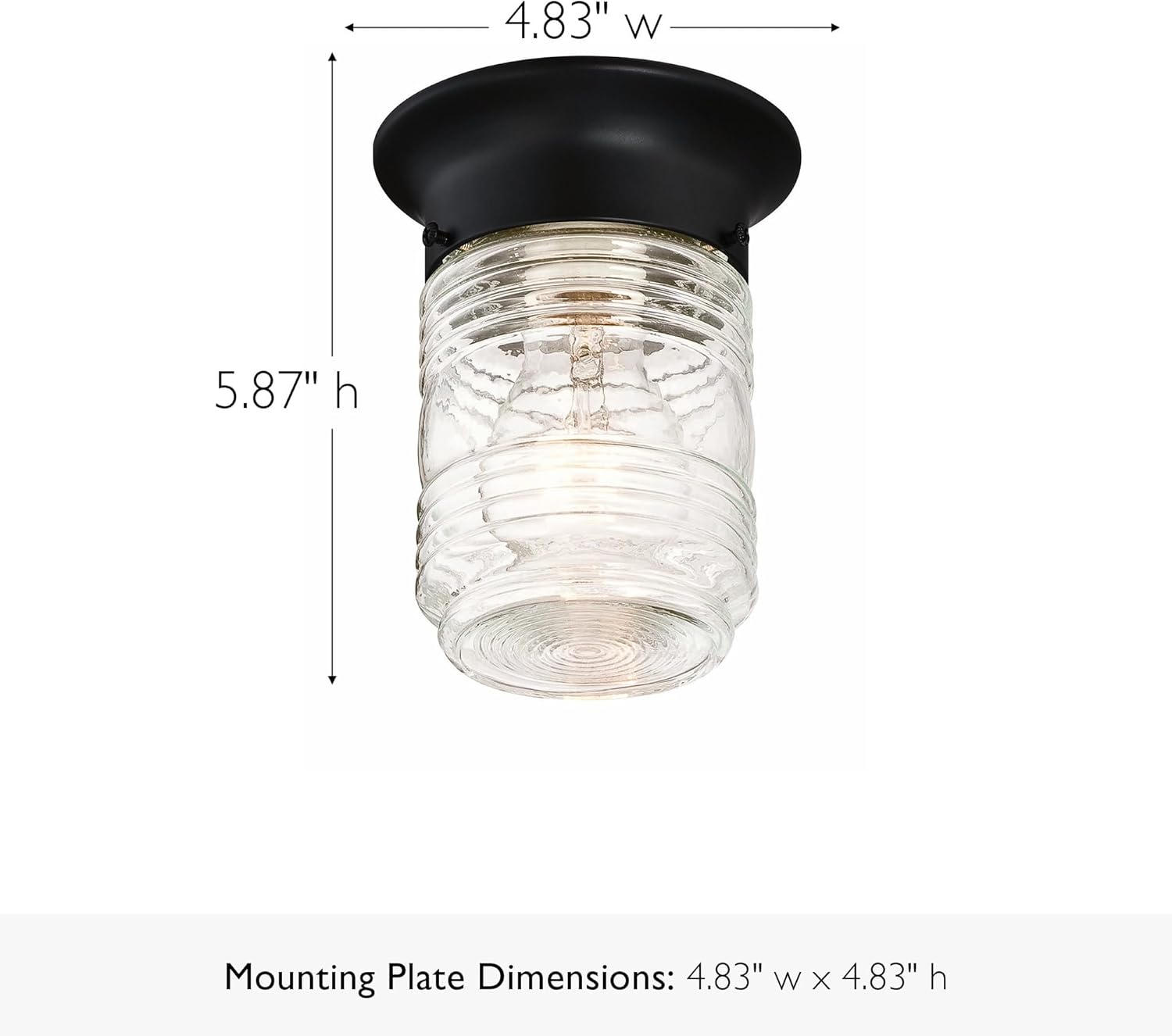
Entry-level jelly jar flush mounts in the $30–$55 range serve a clear purpose: replacing builder-grade flood lamp housings on porch ceilings. This is a fixture for someone who wants character without a complicated installation or a high price commitment. The glass globe sits protected within the cage frame, and the socket housing is sealed at the ceiling plate — the construction logic that makes the damp-rated claim credible in real-world covered-porch conditions.
The tradeoff to name explicitly: the jelly jar form factor is optimized for a single medium-base bulb, which caps your lumen output. For porches over roughly 80 square feet, you’ll want either a second fixture or a semi-flush with a larger globe that accommodates a higher-lumen LED. A single jelly jar running a standard 800-lumen A19 bulb delivers ambient lighting, not task lighting — appropriate for a porch conversation area, not for a stair landing where clear visibility is required.
Design
$17.05
In stock on Amazon
Check price on AmazonMid-Tier: Amber Ribbed Brass Semi-Flush
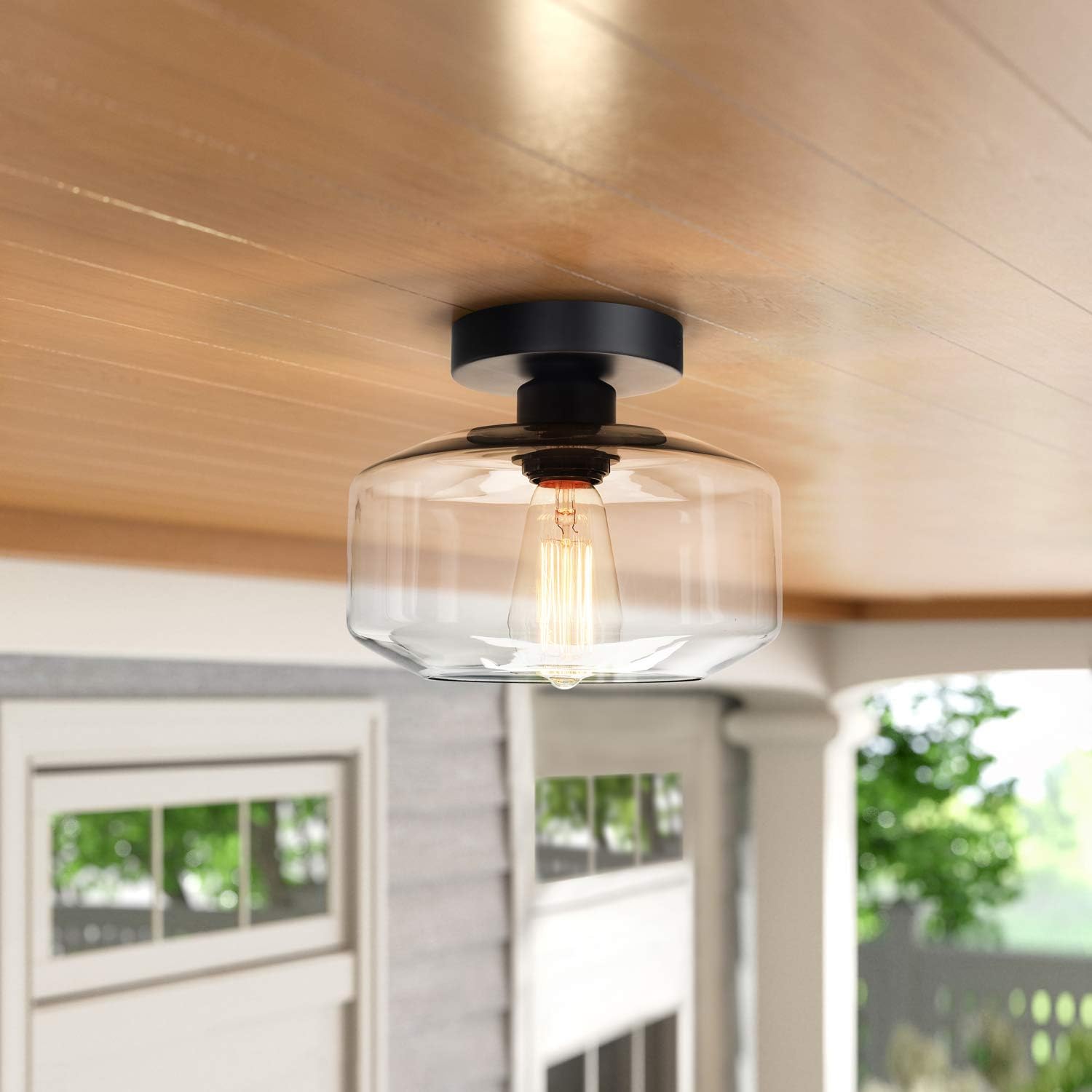
The semi-flush category — fixtures that drop two to six inches from the ceiling rather than sitting flush — solves a specific problem the jelly jar doesn’t: ceiling-to-globe clearance for larger glass forms. The dimensional discipline of a well-proportioned semi-flush resolves clearance conflicts with adjacent upper cabinets, porch soffits, or low-pitched rooflines that a full pendant cannot navigate.
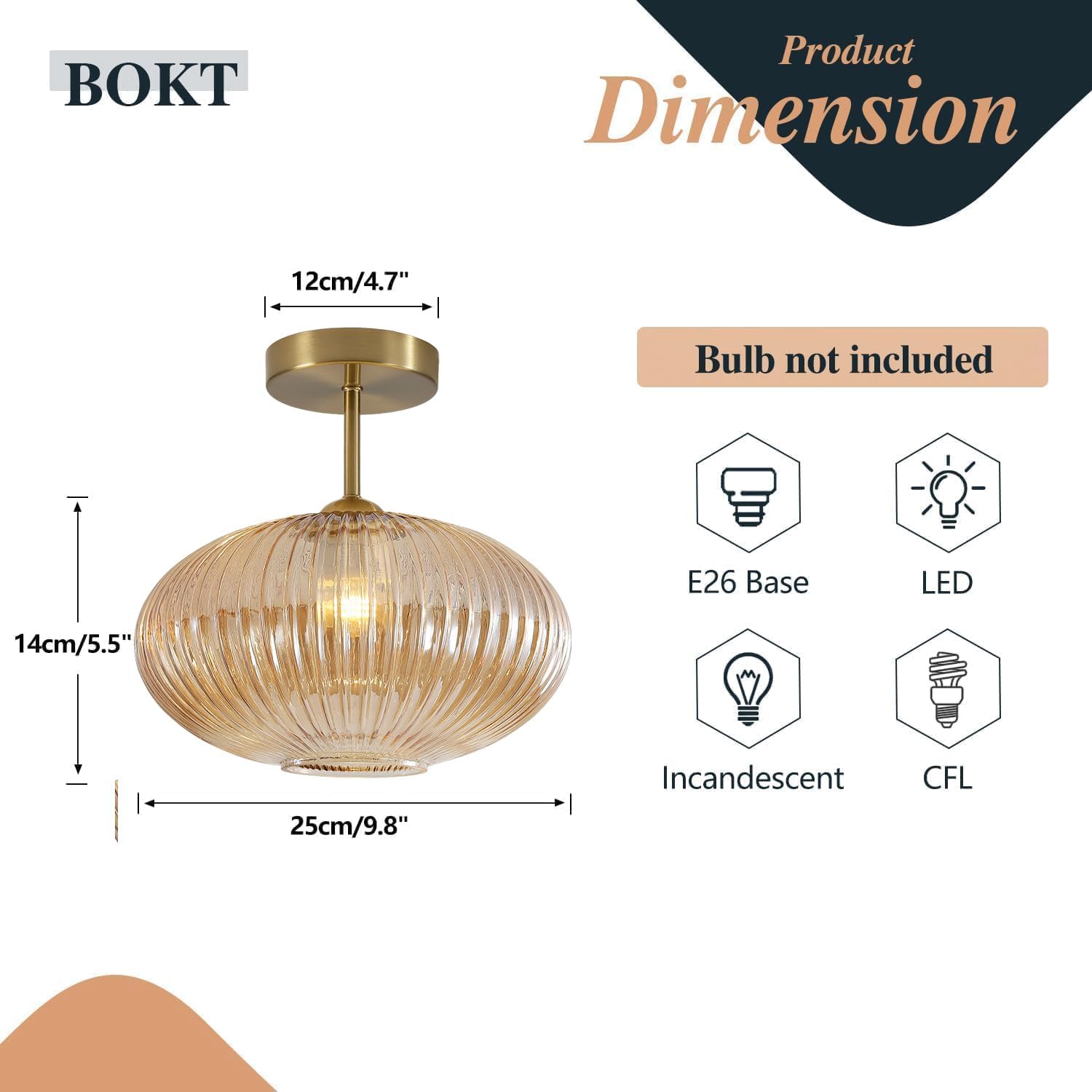
The amber ribbed brass semi-flush introduces a material variable that deserves its own design discussion: ribbed glass — glass with molded parallel channels that refract and scatter light — produces a visually distinct output compared to smooth or seeded glass. Warm-toned light bounces upward and outward in a pattern that uses the ceiling itself as a secondary diffuser. In covered porch applications, this effect is especially pronounced because porch ceilings are typically painted white or light grey — highly reflective surfaces that amplify the scatter. Houzz owner review threads and Q&A discussions on outdoor flush mount glass fixtures (aggregated 2024–2025) consistently describe this ceiling-bounce as the fixture’s most valued quality, often cited as the reason buyers chose it over lower-priced clear-glass alternatives.
The amber glass brightness question is real: colored glass reduces light transmission relative to clear or seeded glass. The practical reduction for amber glass runs roughly 20–35% depending on glass density, based on published specs across the fixture lines reviewed for this article. For ambient porch lighting this tradeoff is acceptable. For task-focused applications, clear or seeded glass is the better choice.
MAXvolador
$23.99
In stock on Amazon
Check price on AmazonPremium Tier: Green Prismatic Glass Semi-Flush
The green prismatic glass semi-flush occupies the upper end of this category — not because of raw material cost, but because of the specificity of its visual effect and the installation discipline it requires to perform correctly.
Owner reviewers across Houzz Q&A threads on outdoor flush mount glass fixtures (aggregated 2024–2025) describe the effect with a specific word: starburst. The prismatic quality of green glass in this configuration casts radiating light patterns across surrounding surfaces — more dramatic and directional than the diffuse scatter of amber ribbed glass. The ceiling-and-wall pattern is a deliberate design output of the fixture, not a side effect to manage around.
Multiple reviewers explicitly recommend pairing this fixture with a dimmer switch, and this guide echoes that recommendation directly: if you choose a green prismatic glass semi-flush, install a compatible LED dimmer from the start. Without dimmer control, the starburst pattern can read as visually overwhelming rather than atmospheric, especially in smaller covered porches where the ceiling is close and the effect is amplified by proximity. This fixture is a genuine design move in the right setting — a deep covered porch, a barn entry, a carport with character — but it requires the control to match.
BOKT
$75.99
In stock on Amazon
Check price on AmazonBy the Numbers: Glass Type Comparison
| Glass type | Approx. transmission loss | Primary ceiling effect | Dimmer recommended? |
|---|---|---|---|
| Clear / seeded | 0–10% | Even diffuse spread | Optional |
| Amber ribbed | 20–35% | Warm ceiling bounce | Preferred |
| Green prismatic | 25–40% | Starburst pattern | Yes — strongly |
| Opal / milk glass | 30–50% | Soft, even glow | Preferred |
Ranges based on published spec comparisons across fixture lines reviewed. Transmission loss varies by glass density and manufacturer.
Finish Longevity Outdoors: Matte Black, Aged Brass, and What Actually Holds
Houzz owner review threads on outdoor flush mounts (aggregated 2024–2025) consistently surface the same finish durability question: will matte black rust, and will brass-tone hardware turn green?
Matte black powder-coat finishes on properly prepared steel or aluminum housings hold well in damp-rated environments. The documented failure mode, when it occurs, is at cut edges or hardware contact points where the coating is thinner — a material reality of powder-coat application, not a brand-specific defect. In wet-rated, direct-exposure environments, expect accelerated wear at those points regardless of finish quality.
Unlacquered or lightly lacquered brass-tone finishes will develop patina in humidity. That is not a defect; it’s the material behaving correctly. Whether you want that outcome depends on the design intent. In most industrial and farmhouse applications — the aesthetic movements Architectural Digest catalogued in “Industrial Lighting Ideas That Work in Every Room” — the aged-brass look is part of the goal, and the patina is a feature. If you’re pairing with other bright-polished hardware, the mismatch will show within one outdoor season.
Frequently Asked Questions
What is the difference between damp-rated and wet-rated for outdoor glass fixtures? Damp-rated fixtures handle moisture-laden air and indirect water contact — appropriate for covered porches, carports, and bathrooms without direct spray. Wet-rated fixtures are engineered for direct rain, hosing, and open-sky exposure. The critical variable is whether water can directly contact the fixture, not how much rain your climate receives. (Sources: This Old House, “How to Choose Outdoor Lighting”; Apartment Therapy, “The Difference Between Damp-Rated and Wet-Rated Outdoor Lights”; Illuminating Engineering Society, IES TM-15-11.)
Can I use a jelly jar light in a completely exposed outdoor location? Only if it carries a wet rating — and most decorative jelly jar fixtures are damp-rated only. Using a damp-rated fixture in a fully exposed location risks socket corrosion, glass seal failure, and voided warranty. If direct exposure is unavoidable, look specifically for a wet-rated designation in the product spec sheet before purchasing.
Will a matte black finish rust or fade outdoors over time? Powder-coated matte black on properly prepared steel or aluminum holds well in covered, damp-rated conditions. Expect gradual wear at hardware contact points over two to three seasons. In direct-exposure or coastal environments, surface rust at cut edges is a documented pattern in owner reviews aggregated on Houzz (2024–2025).
Does colored glass — amber or green — significantly reduce the brightness of the fixture? Yes, meaningfully but not catastrophically. Amber ribbed glass reduces light transmission by roughly 20–35%; green prismatic glass runs 25–40% depending on density. For ambient porch lighting this is typically acceptable. For task-focused applications, choose clear or lightly seeded glass and compensate with higher-lumen bulbs.
What bulb type and wattage works best in a small jelly jar fixture? Medium-base LED A19 bulbs in the 800–1,100 lumen range perform best in this form factor. Bulb color temperature matters: 2700K (warm white) reads most naturally with amber or clear glass; 3000K is a reasonable upper limit. Avoid daylight-range bulbs (5000K or higher) in any decorative glass fixture — the color rendering conflicts with the warm material palette most buyers are building toward.
Can I use a damp-rated flush mount in a bathroom? Yes — damp-rated certification is specifically defined to include bathroom environments without direct shower spray contact. Mount it outside the shower zone and you’re within the rating’s intent. For installations directly above a tub or shower enclosure, a wet rating is required by most local electrical codes.
The Decision Rule
Before you commit to any fixture in this category, run this check:
- Covered porch, indirect moisture only → damp-rated is correct. Prioritize glass character (ribbed, amber, green) and finish patina behavior. The classic jelly jar flush mount is the low-risk entry point; the amber ribbed and green prismatic semi-flush options offer more visual payoff at a higher price.
- Open exposure or direct rain possible → wet-rated only. Accept the narrower glass selection.
- Ceiling clearance under 8 feet → jelly jar flush mount over semi-flush. The reduced drop profile matters more than globe size in tight spaces.
- Atmosphere over raw output → colored glass plus dimmer. The green starburst and amber ceiling-bounce effects are genuine design moves, not compromises — but they require dimmer control to remain atmospheric rather than overwhelming.
- Task lighting need on a large porch → clear or seeded glass, higher-lumen bulb, consider two fixtures. No single small jelly jar solves a 150-square-foot deck.
The fixtures in this category are doing real design work at accessible price points. The tradeoffs are specific and knowable — which means there’s no reason to guess wrong.