June 7, 2026 • Odalys Ferreira • 10 min reading time • Prices verified June 18, 2026
Milk Glass and Vintage Brass Pendants: The Pleated Globe Revival and How to Avoid the Cheap Imitations
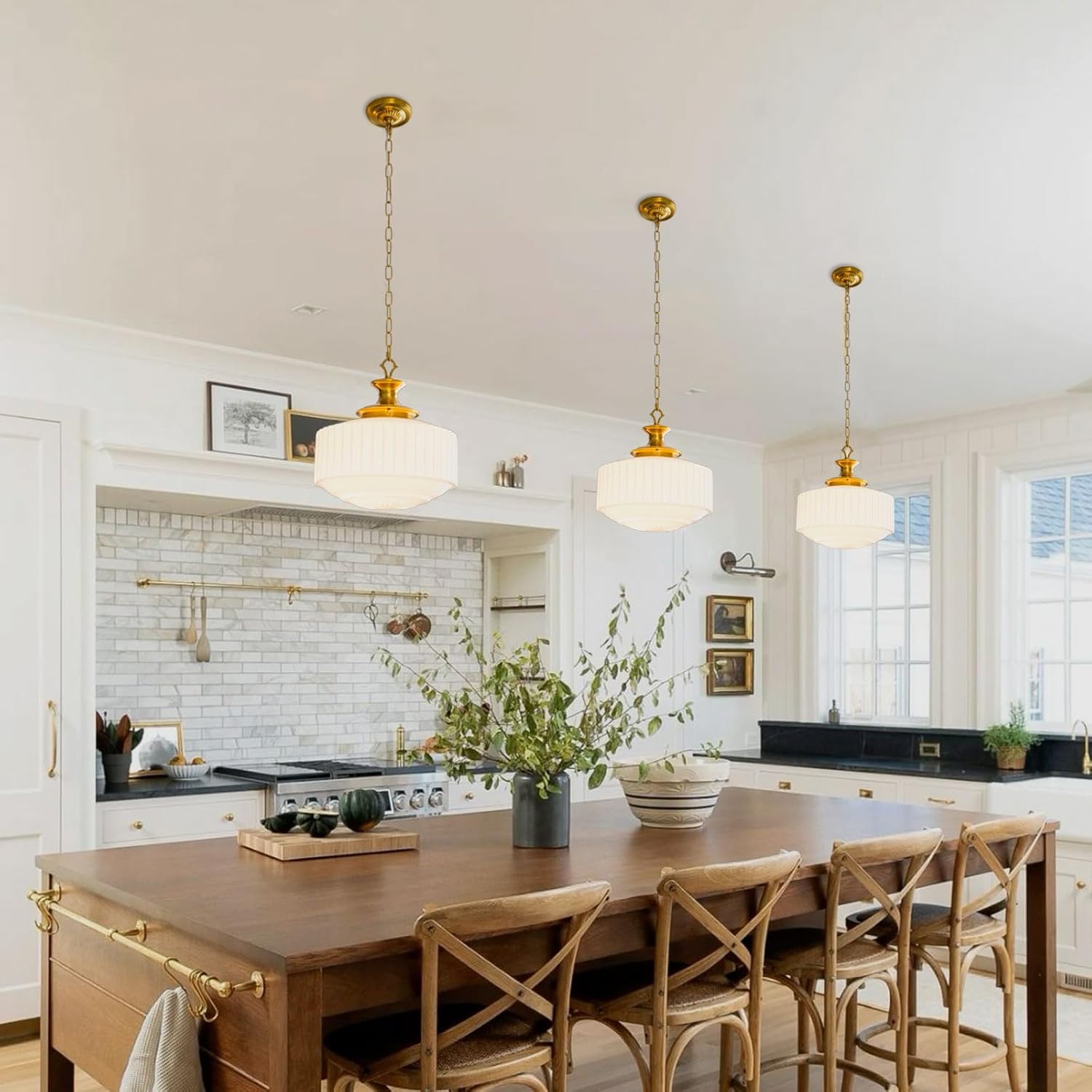
You found a pendant that looks exactly like the one in that 1920s farmhouse kitchen renovation you bookmarked — a soft white globe, slightly ribbed or pleated, suspended on a warm brass stem. It’s called a milk glass pendant (milk glass is an opaque or semi-opaque white glass, distinct from clear or frosted varieties), and right now it is everywhere. The problem is that the $89 version on a mass-market site and the $420 version from a lighting specialist can look nearly identical in a product photo. One will look rich and layered in your space for decades. The other will look slightly wrong the moment you unbox it — and you won’t be able to immediately articulate why. This guide breaks down exactly what separates a quality milk glass and vintage brass pendant from a cheap imitation: the glass itself, the hardware finish, the shade profile, and the sourcing signals that matter. By the end, you’ll have a clear decision framework for your current project.
What “Milk Glass” Actually Means — And Why Most Listings Get It Wrong
Milk glass is a specific material category, not just a color. Historically, it refers to opaque white glass produced by adding tin dioxide, arsenic, or fluoride compounds to the glass batch during manufacture, creating a dense, non-translucent finish that scatters light rather than transmitting it. Per This Old House’s electrical and lighting reference guide, authentic period milk glass from the early-to-mid 20th century had a characteristic warmth and slight surface depth that differed noticeably from later machine-pressed versions.
Here is where modern listings go sideways. In current retail language, “milk glass” gets applied to at least four distinct things:
True opaline glass — mouth-blown or pressed, genuinely opaque, with a subtle iridescent quality at the edges when backlit. This is the premium tier. You’ll find it in studio-made American pendants and in the top lines from brands like Rejuvenation and Urban Electric Co.
Machine-pressed milk glass — the mid-tier category. Consistent and clean, less expensive to produce, but lacking the slight variation and surface warmth of blown glass. Not bad, but not the same thing.
Frosted or acid-etched clear glass — frequently mislabeled as “milk glass” in marketplace listings. This transmits light differently (you can often see the bulb filament as a hot spot through it) and has a completely different aesthetic. It’s not wrong — but it’s not what you’re shopping for.
Painted or coated glass — the bottom tier. A clear glass globe with a white coating applied afterward. These look flat in person, the coating can yellow or peel over time, and they produce a noticeably harsher light distribution. Houzz aggregated owner reviews from 2024–2025 show a consistent complaint pattern in the one-to-three-star reviews of budget milk glass pendants: “looks fine in photos, chalky and flat in person.”
The tell: hold the shade (or look closely at a product photo shot in daylight) and examine the edge profile where light catches it. True opaline milk glass has a slightly translucent halo at the thinnest points — edges, rims, the peaks of pleating — before going fully opaque in the body. Painted glass stays uniformly white throughout. Machine-pressed glass often has a sharper, more consistent surface texture with no variation.
The Pleated Globe Specifically: Why the Profile Matters
The pleated globe — sometimes called a melon shade, a ribbed globe, or a schoolhouse globe variant — is the silhouette driving the current revival. Architectural Digest’s 2025 trend report specifically noted the return of pleated and ribbed milk glass as part of a broader appetite for “soft materiality and handcraft legibility” in lighting design. Apartment Therapy’s March 2025 piece on milk glass fixtures quoted multiple designers citing the profile’s ability to “hold a room without competing with it.”
The pleating does real design work. Each vertical rib creates a micro-shadow that gives the shade visual depth, so it reads as dimensional rather than bulbous. When light is on, the ribs diffuse the glow unevenly in a way that feels warm and organic — a characteristic that flat globes and drum shades can’t replicate.
Where the cheap versions fail on profile:
The number of pleats matters. Period-accurate pleated globes typically have 12–16 defined ribs. Budget versions often have 8–10 shallower ribs that read as “bumpy” rather than “pleated” — the shadow structure collapses and the shade looks closer to a textured globe than an architectural one.
The depth of the pleat matters. Authentic versions have ribs that cut visibly inward — you can see the ridge-and-valley structure clearly. Machine-pressed budget versions frequently have shallower ribs that telegraph as surface texture rather than form.
The rim profile matters. A well-made pleated globe has a clean, slightly thickened rim where the ribs terminate — this is structurally necessary in hand-pressed and mouth-blown glass and produces a finished, intentional look. Budget versions often have thin, slightly uneven rims that show the economy of the process.
Vintage Brass Hardware: Lacquered vs. Unlacquered vs. Plated
If the glass is the shade, the hardware is the signature — and this is where “vintage brass” as a category fragment completely.
Solid unlacquered brass is the premium standard. It starts bright and warm, then develops a natural patina (a surface oxidation layer) over 6–18 months depending on humidity, skin contact, and ambient air quality. Elle Decor’s January 2026 piece on unlacquered brass finishes quoted designer Nate Berkus describing the patina as “proof of presence” — the fixture records its environment. This is the finish on Rejuvenation’s Portland Collection and on most Roll & Hill and Urban Electric Co. hardware.
Lacquered brass is the mid-tier. A clear coating locks in the factory-bright finish and prevents patina development. This is fine if you want consistent color over time and don’t want to think about maintenance. The downside: the lacquer eventually clouds, scratches, or peels (typically 5–10 years in a kitchen or bathroom environment), and refinishing lacquered brass is a more involved process than simply allowing unlacquered brass to age.
Brass-plated steel or zinc is the budget-tier signal. The plating is thin — often measured in microns — and it chips, tarnishes irregularly, and doesn’t patina so much as degrade. Per Rejuvenation’s product specification sheets for their 2025 Portland Collection, their hardware is solid brass throughout; they flag this explicitly because it’s a genuine differentiator at their price point.
How to identify in a listing: Look for the phrase “solid brass” vs. “brass finish” or “brass-tone.” “Brass finish” is almost always plating. Check the product weight — solid brass hardware is substantially heavier than plated steel, and reputable sellers include this in specs. For pendants in the $150–$350 range, solid brass hardware is achievable; at $80–$120, treat “vintage brass” as a color descriptor, not a material claim.
By the Numbers
| Price tier | Glass type typically found | Hardware reality | Expected lifespan |
|---|---|---|---|
| $80–$150 | Painted/coated or thin machine-pressed | Brass-plated steel or zinc | 3–7 years before visible degradation |
| $150–$350 | Machine-pressed milk glass or opaline | Lacquered or solid brass (verify) | 10–20 years with normal care |
| $350–$600 | Quality pressed opaline, some mouth-blown | Solid brass, lacquered or unlacquered | 20+ years; patinas and improves |
| $600+ | Mouth-blown or studio opaline | Solid unlacquered brass or blackened steel | Indefinite; collector-grade |
Sourcing Signals: What to Look For Before You Buy
After comparing specs across 40+ pendants in this category and reading owner reviews at length, here is the sourcing checklist that consistently separates the reliable from the regrettable:
Glass description specificity. A quality listing says “opaline glass,” “pressed milk glass,” or “mouth-blown glass.” A vague listing says “white glass shade” or “milk glass-style.” Specificity signals that the manufacturer knows what they made.
Country of manufacture for the glass. American-made glass (Rejuvenation sources domestically; Urban Electric Co. produces in Charleston, SC) and Czech-made glass (a historic center for quality pressed opaline production) are reliable provenance signals. This is not a blanket criticism of other origins — there are quality manufacturers elsewhere — but unspecified origin in a budget listing is a flag worth noting.
Dimmer compatibility and bulb type specification. Quality fixture makers list their dimmer compatibility explicitly (often by brand: Lutron Caseta, Leviton, etc.) because they’ve verified it with their glass and socket combination. Budget fixtures list “dimmable” as a checkbox without specifics. This matters for milk glass in particular: the correct bulb color temperature is 2200K–2700K (warm white to soft white) to complement the glass’s natural warmth; a 3000K+ bulb pushes milk glass into a clinical, slightly greenish read that ruins the effect.
Lead time transparency. Studio-blown and American-made pendants in this category currently run 6–14 weeks on lead time (as of mid-2026). If a listing claims “ships in 3–5 days” for what it describes as hand-crafted or made-to-order American glass, that’s a discrepancy worth investigating — either it’s not what the description implies, or the inventory is pre-made offshore and rebranded.
Return policy specifics. Reputable lighting specialists (Rejuvenation, Lumens, YLighting, Schoolhouse) offer fixture return windows of 30–90 days and handle glass damage in transit with replacement protocols. Budget marketplace sellers frequently list “all sales final” for glass items. Factor this into your total-cost calculation, especially for multi-pendant installations where one shade mismatch in a set of four is genuinely painful.
The If/Then Decision Matrix
If you are speccing a single pendant for a rental kitchen refresh and the budget ceiling is $200: machine-pressed opaline from Schoolhouse or a similar mid-tier specialist is your floor. Do not go below this unless the listing explicitly states solid brass hardware and names the glass type. A $120 mystery pendant almost certainly has plated hardware and coated glass.
If you are sourcing 3–6 pendants for a kitchen island in a client project at the $800–$2,500 total budget: Rejuvenation’s Portland Collection or Schoolhouse’s Blake pendant (both spec solid brass and pressed opaline) are proven workhorses in this tier. Houzz owner reviews consistently cite color and finish consistency across multi-unit orders — a real concern with mouth-blown glass at the studio tier.
If the project is a statement installation — dining room, entryway, great room — with budget flexibility above $400 per fixture: go mouth-blown. Urban Electric Co.’s custom program and Roll & Hill’s studio pieces allow you to specify the exact opaline density and pleat depth. At this price point, the provenance and visual specificity are the product. Architectural Digest and Elle Decor both cite Urban Electric Co. by name as a benchmark for American-made milk glass quality.
If the hardware finish needs to age alongside unlacquered brass plumbing or cabinet hardware already in the space: specify unlacquered brass explicitly and budget 12–18 months for the pendant hardware to catch up in patina. Do not try to match a new fixture to aged hardware — specify unlacquered on both, let them age together, and embrace a 6-month transition period where they look different. It resolves. Trying to color-match aged brass with a lacquered “antique brass” finish almost never does.
The pleated globe revival is real, the aesthetic payoff is significant, and the quality range in this category is wider than almost any other pendant type on the market right now. The gap between a $95 imitation and a $385 genuine article is not always visible in a product photo — but it will be visible in your space, in your owner review six months from now, and in whether the fixture is still worth looking at in ten years. Spend the fifteen minutes on the sourcing checklist. It’s the difference between a fixture that anchors a room and one that quietly apologizes for itself.