June 10, 2026 • Odalys Ferreira • 12 min reading time • Prices verified June 18, 2026
Mid-Century Modern Globe Pendants: Milk Glass, Opal, and the MCM Revival Done Right
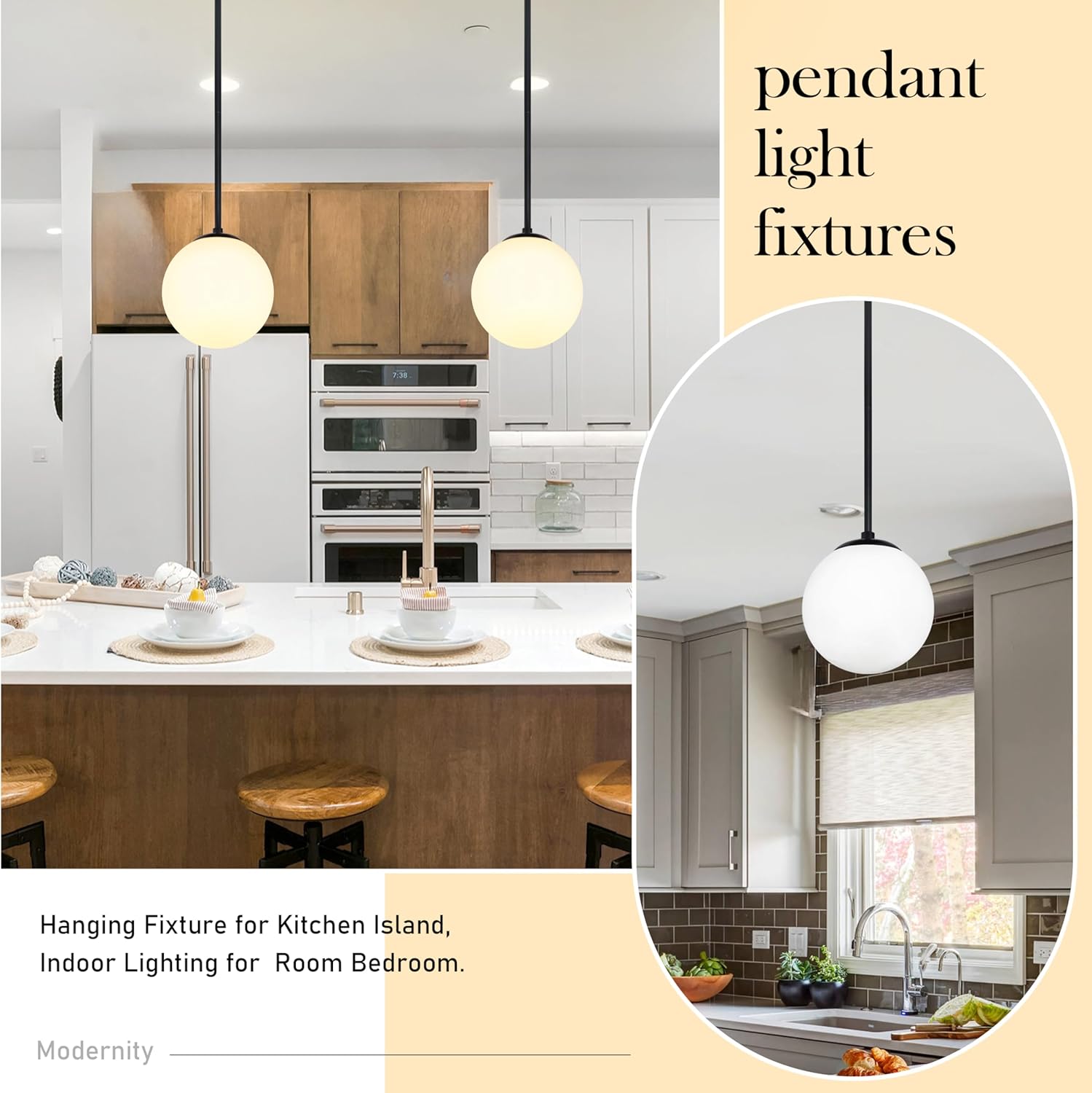
You found the perfect globe pendant — the one with that frosted, luminous shade that practically glows from across a showroom floor. But now you’re staring at three versions of the same silhouette across three price points, the specs use words like “opal,” “milk glass,” and “mouth-blown” interchangeably, and you’re not sure if the 12-inch diameter is going to read as a statement or disappear into your ceiling. That’s exactly the decision this article is built for.
A globe pendant is exactly what it sounds like: a spherical or near-spherical shade — usually white, usually glass — hanging from a ceiling canopy on a cord or rod. The mid-century modern (MCM) version pairs that shape with simple hardware in brushed brass, matte black, or antique gold, and leans on the glass itself to do most of the aesthetic work. The two glass types you’ll encounter most often are milk glass (an opaque white glass, historically made with tin dioxide or bone ash, that blocks most direct light and creates a soft, even glow) and opal glass (slightly translucent, with a milky core that transmits more light than milk glass while still diffusing the bulb). Getting that distinction right changes which fixture you choose — and which bulb you pair it with.
After comparing specs across 40-plus globe pendant fixtures and reading through hundreds of owner reviews, here’s what we found.
| EDITOR'S PICK[CLAXY Modern Gold Schoolhouse C…](https://www.amazon.com/dp/B0DFLGSX9J?tag=greenflower20-20) | Mid-tier[Bagood 10 Inch Globe Pendant Li…](https://www.amazon.com/dp/B0DBZCG7J1?tag=greenflower20-20) | Budget pick[Bagood 6 Inch Globe Pendant Lig…](https://www.amazon.com/dp/B0DBZJ2FTW?tag=greenflower20-20) | |
|---|---|---|---|
| Diameter | — | 10 Inch | 6 Inch |
| Adjustable | — | ✓ | — |
| Dimmable | ✓ | — | — |
| Mount Type | Semi-Flush Mount | Pendant | Pendant |
| Price | $99.00 | $83.99 | $39.99 |
| See on Amazon → | See on Amazon → | See on Amazon → |
Milk Glass vs. Opal Glass: The Diffusion Decision That Drives Everything
This is the fork in the road, and most shoppers underestimate it.
Milk glass is dense and almost fully opaque. Light passes through it, but you won’t see a bulb filament or hotspot. The result is a lantern-like quality — the globe itself becomes the light source visually. This makes milk glass the more forgiving option for imperfect bulbs (standard A19 shapes work fine) and the better choice for spaces where you want a decorative object that also provides ambient light rather than task illumination.
Opal glass sits between milk glass and clear glass on the translucency spectrum. It has that characteristic bluish-white shimmer at its edge — like the inside of an abalone shell — and passes more lumens. You’ll get slightly more directionality from an opal shade, which means bulb placement and shape matter more. A globe-shaped LED inside an opal shade will look rounder and more intentional than an A19, because the shape silhouettes faintly through the glass.
The IES Illuminating Engineering Society, in their Residential Lighting Design Guide (2023 edition), identifies diffuse luminaires — the category globe pendants fall into — as the recommended fixture type for residential spaces where glare control and visual comfort are priorities, particularly kitchens and dining rooms with reflective surfaces. The denser the glass, the more complete the diffusion.
The practical tradeoff:
| Glass Type | Light Output | Bulb Visibility | Best Use Case |
|---|---|---|---|
| Milk glass (opaque) | Lower lumen transmission | None | Ambient, decorative, forgiving |
| Opal glass | Moderate transmission | Faint silhouette | Ambient + task blend, more punch |
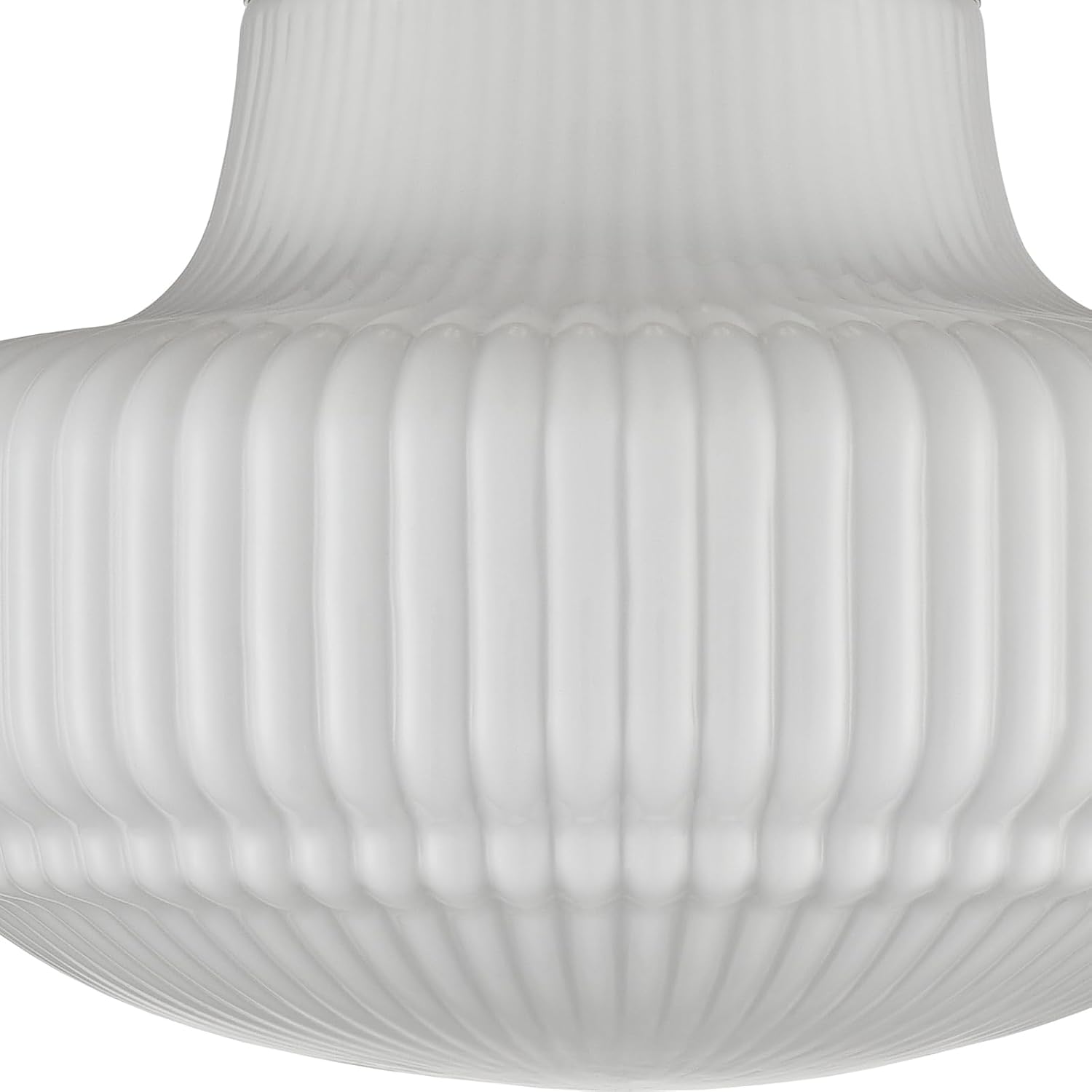
| Pleated milk glass | Lower (more surface scatter) | None | Statement decorative layer |
Dwell Magazine, in their Glass Pendant Buying Guide (2024), notes that pleated or ribbed milk glass surfaces scatter light even more laterally than smooth milk glass, creating a warmer halo effect that reads well in kitchens with open sightlines.
Size Management: The Mistake That Sends Fixtures Back
One of the most consistent patterns across owner reviews — across multiple globe pendant styles — is size miscalculation. Buyers regularly report returning fixtures because the shade was physically larger than they’d visualized from the product page, pivoting to semi-flush mounts to solve for ceiling height. That’s a $60–$150 restocking lesson you don’t have to pay.
The standard sizing rules, as reported by Apartment Therapy in their 2025 Globe Pendant Lighting Trend Report and confirmed in Houzz Mid-Century Modern Kitchen Lighting community discussions (2025):
- Dining table pendants: Globe diameter (in inches) should equal roughly one-third of the table width. A 36-inch table calls for a 12-inch globe.
- Kitchen island pendants in a row: 8–12 inch globes work for standard 7–8 ft ceilings. Anything over 14 inches starts crowding visual space when multiples hang together.
- Single statement pendant over a seating area: A single large globe (16–18 inches) over a chair grouping reads as sculpture, not lighting — which can be exactly the intent.
Hanging height matters equally. The IES Illuminating Engineering Society guideline for dining pendants is 30–36 inches above the table surface. For kitchen islands where people stand, 60–66 inches from the floor to the bottom of the shade is the working target.
The spatial perception benefit is real and documented in owner reviews: multiple buyers specifically noted that replacing a ceiling fan with a single globe pendant made the kitchen “feel larger.” That’s not coincidence — a ceiling fan draws the eye to the ceiling plane and competes with it; a pendant pulls the eye through the room’s vertical axis and simplifies the visual field. Architectural Digest, in their MCM Revival coverage (2024), cites this visual clearing-out as one of the primary reasons mid-century modern style resonates in contemporary renovations.
A low-cost pre-visualization trick: Cut a circle of kraft paper to the globe’s exact diameter and tape it to the ceiling at the planned cord length before ordering. It takes four minutes and has saved countless returns.
Globe Pendant Tiers: Budget, Mid, and Premium
The globe pendant market breaks into three meaningful tiers, and understanding where the value actually lives prevents both overspending and under-buying.
Entry-Tier Pleated Milk Glass Pendants ($80–$160)
Bagood
$39.99
In stock on Amazon
Check price on AmazonEntry-tier pleated milk glass pendants — typically imported, machine-pressed fixtures with plated brass or matte black hardware — represent the largest share of the online market for this style. Multiple independent reviewers use phrases like “looks just like the very expensive ones” without prompting, which tells you something real about where the visible design gap between this tier and the designer tier actually lives: it isn’t in appearance at typical room distances.
The pleated milk glass silhouette, influenced by classics like the Schoolhouse Electric Arlo and the Visual Comfort Darlana, reads identically at ten feet. What you give up is glass-wall consistency (machine-pressed glass shows more thickness variation, which can produce uneven glow at the base), hardware longevity (plated brass can dull unevenly over years), and customization options. If the fixture is going into a rental, a flip, or a room you’re still resolving aesthetically, the entry tier does real work.
Mid-Tier Opal and Smooth Milk Glass Pendants ($180–$350)
Bagood
$83.99
In stock on Amazon
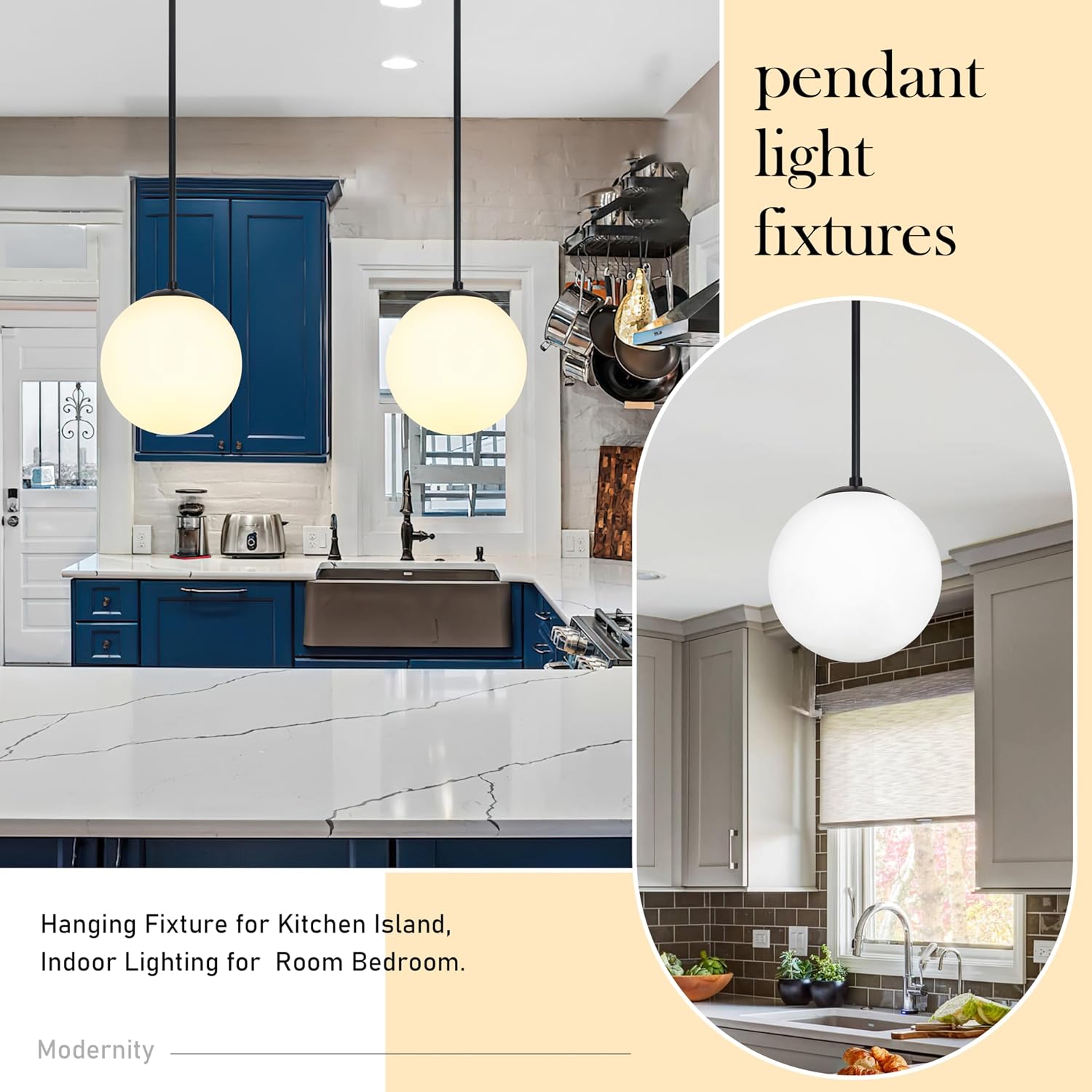
Check price on AmazonThe mid-tier market includes domestic and international brands with better quality control over glass consistency, more durable hardware finishes, and broader configuration options — multiple cord lengths, sloped-ceiling canopy adapters, and finish pairings that entry-tier fixtures don’t offer. Opal glass shades appear more frequently in this tier because the controlled translucency requires more consistent wall thickness to glow evenly.
This is also where dimmability specs become more reliable. Mid-tier fixtures are more commonly tested against standard residential dimmer pairings (Lutron Caseta and equivalent) and document those results in the spec sheet rather than leaving buyers to discover flicker issues after installation. Houzz community discussions on mid-century modern kitchen lighting consistently recommend confirming dimmer pairing in the spec sheet before wiring, not after.
Premium and Designer-Tier Studio Glass Pendants ($400–$800+)
CLAXY
$99.00
In stock on Amazon
Check price on AmazonAt this tier — Roll & Hill, Schoolhouse Electric, Rejuvenation, Visual Comfort — you’re buying studio-blown or American-made glass held to dimensional tolerances that machine-pressing cannot match, hardware that genuinely ages well (unlacquered brass patinas; it doesn’t just dull), and direct access to customization. Need a specific cord length, a non-standard finish, or a sloped-ceiling configuration? This is where those options exist.
The glass won’t look dramatically different at installation compared to a well-made mid-tier piece. It will look right in five years, and the cheaper one might not. If the fixture is anchoring a dining room where you’ve committed $4,000 to other finishes, the investment in provenance is worth it — not because the globe glows differently on day one, but because the fixture holds up to close inspection over the life of the room.
Installation Realities: Fragility, Fit Problems, and a Medallion Trick
Glass fragility is a genuine concern, not a one-off complaint. Across multiple globe pendant reviews, buyers describe shades as “extremely delicate” during installation, and others encountered screw holes that were undersized from the factory. Both are patterned issues.
How to install a milk glass globe shade without breaking it:
- Support the shade from below with a folded towel or have a second person hold it — never let it hang by its own weight against the socket ring until the retaining hardware is fully secured.
- If a screw hole is undersized (a documented issue on some import-tier fixtures), don’t force the screw. Use a small round file or a 1/16-inch bit to clear the hole before threading. Forcing a screw into undersized glass will crack the shade.
- Milk glass is annealed but not tempered — resistant to thermal shock at normal residential temperatures, but not to impact. Set it on carpet or a folded moving blanket during assembly.
This Old House, in their pendant installation reference “How to Hang a Pendant Light,” identifies junction box ratings as the most commonly overlooked installation issue: confirm your box is rated for the fixture weight before installation, particularly for heavier glass globes over five pounds.
The medallion tip: One approach worth borrowing from experienced installers — buy a ceiling medallion, paint it to match the ceiling color, and use it to visually frame the fixture against the ceiling plane. This makes a semi-flush mount read as more intentional, bridges the canopy-to-ceiling transition cleanly, and costs under $30. It’s especially effective in rooms with textured or imperfect ceiling surfaces, and it works at every price tier.
Bulbs, Dimmers, and Color Temperature
Inside a milk glass or opal globe, bulb color temperature is perceptible to anyone who spends time in the room, even if they can’t name it. The glass diffuses but doesn’t filter color.
- 2200–2700K (warm white to soft white): The right range for nearly all milk glass and opal globe applications. This temperature renders the glass as cream-white and flattering. Reviewers describing fixtures as “warm and inviting” are almost universally running bulbs in this range.
- 3000K (bright white): Acceptable in kitchens where task performance matters, but pushes the glass toward a colder, more institutional look.
- 4000K and above: Not recommended in milk glass. The dense glass doesn’t warm the light — it just softens the source — and the result consistently reads as harsh in owner feedback.
Globe-shaped LED bulbs (G25 or G30 form factors) look best inside globe shades because they produce a visually even glow from any angle. Standard A19 shapes work, but the narrower neck creates a subtle hotspot at the bottom of the shade in thinner opal glass.
Dimmer compatibility: Most globe pendants are listed as LED-dimmable, but compatibility depends on the dimmer model, not just the fixture. Houzz Mid-Century Modern Kitchen Lighting community discussions (2025) consistently name the Lutron DVCL-153P as a reliable baseline for residential globe pendants. Confirm the specific pairing in the fixture’s spec sheet — some LED drivers produce flicker at the low end of cheaper triac dimmers.
Frequently Asked Questions
What is the difference between milk glass and opal glass in terms of light diffusion? Milk glass is nearly opaque, blocking most direct light and creating an even, lantern-like glow with no visible bulb. Opal glass is semi-translucent, transmitting more lumens while still diffusing the source — you may see a faint bulb silhouette through opal glass, especially with globe-shaped LEDs.
How fragile are milk glass globe shades and how do I install one without breaking it? They’re genuinely fragile during installation — the glass is annealed, not tempered. Support the shade from below with a second person or folded towel, never let it hang unsupported during assembly, and if screw holes are undersized, clear them with a small drill bit before threading rather than forcing hardware through.
What bulb color temperature works best inside a milk glass or opal globe? 2200–2700K is the sweet spot. It renders the glass warm and creamy and flatters most interior color palettes. Avoid 4000K and above — it pushes milk glass toward a cold, institutional read.
How do I know if a globe pendant will look too large or too small in my space? Use the one-third rule for dining tables (globe diameter equals roughly one-third of table width) and the 60–66 inch floor-to-bottom-of-shade rule for kitchen islands. Cut a circle of kraft paper to the globe’s diameter and tape it to the ceiling at the planned cord length to pre-visualize scale before ordering.
Can I buy replacement milk glass shades for an existing fixture? Yes — Schoolhouse Electric, Rejuvenation, and several specialty glass suppliers sell globe shades as standalone components. Measure the fitter opening (the collar diameter where the shade meets the socket), not the globe’s overall diameter, when ordering a replacement.
Are these fixtures compatible with dimmer switches? Most are listed as LED-dimmable, but compatibility depends on the dimmer model. Lutron Caseta and the Lutron DVCL-153P are the most consistently cited working combinations in owner reviews. Confirm the pairing in the fixture’s spec sheet before wiring.
The Decision Rule
If your ceiling is 8 feet or under and you’re replacing a ceiling fan or bare-bulb fixture in a kitchen or dining room: a 10–12 inch milk glass globe pendant at the entry tier solves the problem cleanly, reads as a real design choice, and — based on reviewer consensus — genuinely changes how the room feels spatially. Start there.
If the room has 9-plus foot ceilings, you’ve committed to a finish palette (unlacquered brass, blackened steel), and this fixture will anchor a space you’re documenting or living with for a decade: move to the premium tier and specify American-made or studio-blown glass. The hardware longevity and customization options justify the price difference. The glass won’t look dramatically different at installation — but it will look right in five years, and the entry-tier piece might not.