May 22, 2026 • Odalys Ferreira • 9 min reading time • Prices verified June 18, 2026
Hammered Glass Pendants: How Texture Differs from Seeded, and Which Finishes Hold Up
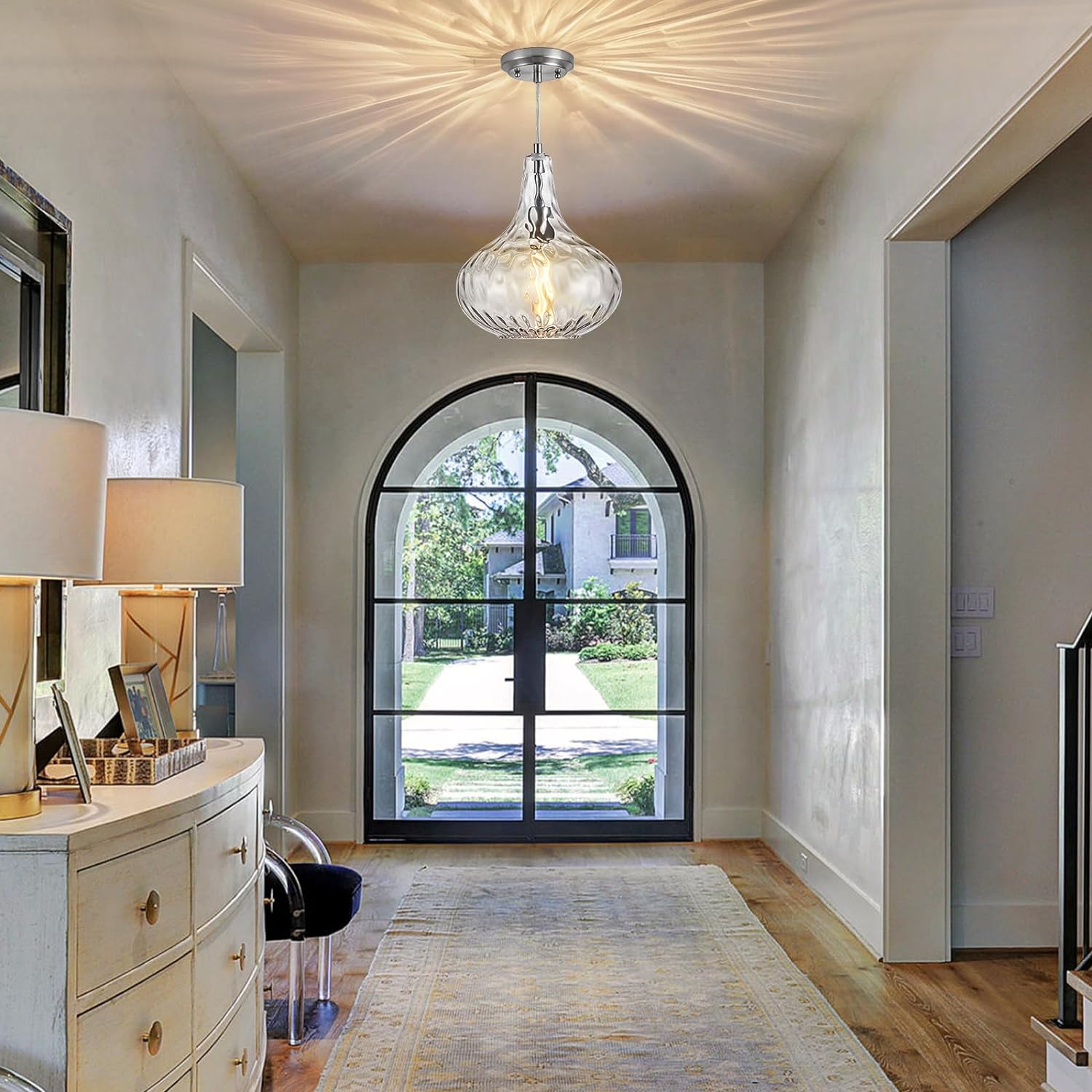
You finally found a pendant with real visual presence — not flat, not fussy, just that tactile quality you keep seeing in kitchen mood boards. But now you’re looking at two options side by side: one described as “hammered glass,” the other as “seeded glass.” They both look textured in the product photo, the price points overlap, and the descriptions are nearly identical. So what’s actually different between them, and does it even matter once the pendant is hanging six feet overhead?
It matters quite a bit, actually — for the character of the light, for how the fixture reads at different distances, and for how the metal hardware holds up over time. This article breaks down the difference between hammered and seeded glass (plus where a few other textures fit in), translates the tradeoffs into practical guidance, and ends with a clear decision frame: if your space looks like X, the right answer is Y.
| EDITOR'S PICK[CATINER Glass Pendant Light Bru…](https://www.amazon.com/dp/B0C1GD8ZV4?tag=greenflower20-20) | Mid-tier[Brushed Nickel Pendant Light fo…](https://www.amazon.com/dp/B0CWRGSCKR?tag=greenflower20-20) | Budget pick[WILON Industrial Glass Pendant…](https://www.amazon.com/dp/B0DKWCG2J1?tag=greenflower20-20) | |
|---|---|---|---|
| Diameter | 11" | 10" | 7" |
| Finish | Brushed nickel | Brushed nickel | Black |
| Adjustable rod | — | — | ✓ |
| Price | $98.99 | $90.53 | $75.99 |
| See on Amazon → | See on Amazon → | See on Amazon → |
What Hammered Glass Actually Is — and How It Differs from Seeded
The terminology here is worth getting precise, because manufacturers use these terms inconsistently and that inconsistency can burn you when a fixture arrives.
Hammered glass gets its texture from a physical process applied to the glass surface — either during the blowing process when the glass is still molten (a glassblower pressing a textured mold or tool into the form) or, in machine-pressed production, by running the glass through rollers or molds with a dimpled pattern. The result is a surface with broad, shallow undulations — like the face of a ball-peen hammer has struck it repeatedly. Each depression is typically 3–8mm across and relatively smooth-edged. The key optical consequence: hammered glass refracts light in wide, gentle arcs. At night with an exposed or semi-exposed bulb, you’ll see sweeping, whale-sized light patterns moving across ceilings and walls. It reads as dramatic and kinetic.
Seeded glass, by contrast, gets its texture from the interior, not the surface. Tiny air bubbles — “seeds” — are intentionally trapped inside the glass body during production. Mouth-blown seeded glass (the traditional method) creates irregularly sized seeds distributed organically through the piece; machine-blown seeded glass produces more uniform bubbles at consistent intervals. The surface of seeded glass is typically smooth or very lightly textured. Its optical effect is subtler: the seeds scatter and soften light rather than redirecting it dramatically. The result reads as warmly diffused rather than kinetic — more candlelight glow, less prism show.
This Old House’s guide to glass types in lighting draws a useful distinction here: surface texture affects the direction of refracted light, while internal texture (seeds, bubbles) affects diffusion quality. Both achieve visual interest, but through opposite mechanisms.
A third texture worth naming: ribbed glass (sometimes called “fluted” or “reeded”) has parallel vertical or horizontal channels pressed or blown into the surface. Ribbed glass splits light into defined vertical stripes — crisper and more architectural than hammered, less organic than seeded. It’s had a strong run in 2024–2026 kitchen and bath spec work, per Architectural Digest’s coverage of emerging pendant trends.
The Math on Light Output: What Texture Costs You
Glass texture is not free from a lumen-delivery standpoint. Every surface treatment that scatters or refracts light reduces the net lumens reaching your countertop or table. Here’s a rough working model based on published manufacturer specs and Lighting Design Lab’s diffusion reference data:
Texture vs. Light Transmission (approximate)
- Clear glass (no texture): ~92% light transmission
- Hammered clear glass: ~78–84% (surface refraction)
- Seeded clear glass: ~80–86% (internal scattering, varies with seed density)
- Opaline / milk glass: ~45–60% (dense diffusion — a different category entirely)
Two practical implications: First, if you’re spec’ing hammered or seeded pendants over a task surface — an island, a desk, a dining table you actually use for reading — compensate with a higher-lumen bulb or an additional source. Second, the difference between hammered and seeded in pure transmission terms is modest (within ~6 percentage points at comparable densities). The choice between them is mostly aesthetic and contextual, not a lumen-delivery decision.
Houzz’s 2024 editorial survey on kitchen lighting regrets found that the most commonly cited issue wasn’t fixture style — it was insufficient lumen output at the task surface, especially in kitchens where pendants replaced recessed cans without supplemental lighting being added. Worth flagging to clients before they fall in love with a fixture’s look.
Finish Pairings: Which Metals Actually Hold Up with Glass Pendants
This is where practitioners lose money or client goodwill, usually eighteen months after installation when a finish starts doing something unexpected.
Unlacquered brass is having a sustained moment — and for good reason. It develops a warm, living patina that deepens over time, especially in humid environments like kitchens and baths. Paired with hammered glass, unlacquered brass reads as artisanal and historically grounded; paired with seeded glass, it softens into something almost Colonial Revival. The tradeoff is real, though: unlacquered brass requires client buy-in on the aging process. Apartment Therapy’s finish guide notes that clients in high-humidity coastal environments see visible patina shifts within 6–12 months; drier inland climates may take 2–3 years to show comparable change. If your client wants brass that stays bright, they need lacquered brass — which will eventually chip and look worse than patina would have, or satin brass (a brushed, coated finish that reads warmer than polished but doesn’t age).
Blackened steel (also called “matte black” in most retail listings, though true blackened steel is a chemical oxidation process and matte black is often a powder coat — these behave differently) is the most durable finish category for pendant hardware at the $200–$800 retail tier. Powder-coat matte black is chip-resistant, doesn’t react to humidity, and reads as high-contrast against both hammered and seeded clear glass. The risk is trend exposure: matte black fixtures saturated the market between 2019–2023, and some designers are already speccing away from it in favor of more material-specific finishes. For rental and flip applications, it remains a safe, low-maintenance choice. For design-forward projects, true blackened steel from studios like Roll & Hill or Allied Maker carries more material authenticity.
Polished nickel pairs exceptionally well with seeded glass — the cool undertone of the metal balances the warm diffusion of the glass without fighting it. It’s more maintenance-intensive than matte finishes (fingerprints are visible, water spots accumulate near sinks), but owners consistently report that it photographs better than any other finish, which matters in short-term rental contexts. Polished nickel over hammered glass can read as slightly too slick — the two textures compete rather than complement.
Aged/antique bronze is the chameleon finish: it pairs credibly with both glass types, skews traditional, and is genuinely durable because the “aged” appearance means minor surface wear is invisible rather than conspicuous. For clients with eclectic or transitional interiors who want a fixture that won’t date itself quickly, this is often the lowest-risk choice.
Mouth-Blown vs. Machine-Pressed: Why It Matters for Hammered Glass Specifically
For seeded glass, the mouth-blown vs. machine-pressed distinction primarily affects bubble distribution (organic vs. uniform) and price. For hammered glass, the distinction is more consequential.
Mouth-blown hammered glass — where a glassblower gathers molten glass, blows the basic form, and then works texture into the surface while the glass is still plastic — produces a form that is genuinely one-of-a-kind. The hammer marks vary in depth and spacing, the glass wall thickness is uneven (intentionally), and the refraction pattern the fixture throws is complex and non-repeating. Studios producing this work in the US include Ochre’s lighting division (UK/US) and various artisan studios distributed through Lumens and YLighting. Lead times for studio-blown pieces currently run 10–16 weeks as of early 2026, based on informal retailer tracking.
Machine-pressed hammered glass replicates the aesthetic at volume. The hammer pattern repeats identically across every unit; wall thickness is uniform; light refraction patterns are predictable and consistent — which can actually be a feature in commercial or multi-fixture installations where you want coherent visual repetition. For a three-pendant run over a kitchen island, machine-pressed consistency can be more visually refined than the slight variation you’d get from three individually blown pieces.
Neither is categorically better. The decision frame is: bespoke character vs. repeatable precision, which maps fairly directly onto residential artisan projects vs. commercial or production-build work.
The Practical Decision Frame
After comparing specs across 40+ pendants and reading through owner reviews on Houzz, Lumens, and YLighting, here’s how the if/then logic shakes out:
If your priority is dramatic nighttime presence — a fixture that creates movement and shadow play when lit — choose hammered glass. Pair with unlacquered or aged brass for warmth, or blackened steel for high contrast. Use a dimmable filament or warm-white LED (2200–2700K) to maximize the refraction effect. Flat cool-white bulbs (3000K+) wash out the texture visually.
If your priority is ambient warmth and daytime legibility — a fixture that reads beautifully at all hours without dominating — choose seeded glass. Polished nickel or satin brass are the strongest finish pairings. Seeded glass is more forgiving of bulb choice but still rewards a warm color temperature.
If you’re spec’ing for a rental or high-turnover environment, choose machine-pressed in either texture with a powder-coat matte black or dark bronze finish. These are the lowest-maintenance combination across humidity, handling, and cleaning.
If you’re spec’ing for a design-forward client with a meaningful budget ($600–$2,500 for a single pendant), consider mouth-blown hammered glass in aged or unlacquered brass, with the explicit client conversation about patina aging built into your presentation. The Lighting Design Lab’s diffusion reference is a useful leave-behind if a client questions why a $1,400 studio-blown piece looks “less perfect” than a $180 machine-pressed version — imperfection is the point, and knowing how to explain that is part of the spec conversation.
On finishes over time: if the project is in a coastal or high-humidity zone, steer away from unlacquered brass unless your client actively wants patina. In dry inland climates, unlacquered brass is lower-risk and ages more gracefully. Matte black and dark bronze are climate-agnostic.
The clearest single-sentence rule: hammered glass amplifies a bulb’s drama; seeded glass softens it. Everything else — finish choice, mount style, bulb temperature — is calibration around that core difference.