June 6, 2026 • Odalys Ferreira • 9 min reading time • Prices verified June 18, 2026
Green and Amber Glass Pendants: Colored Glass Done Right, From Ribbed Sage to Honey Amber
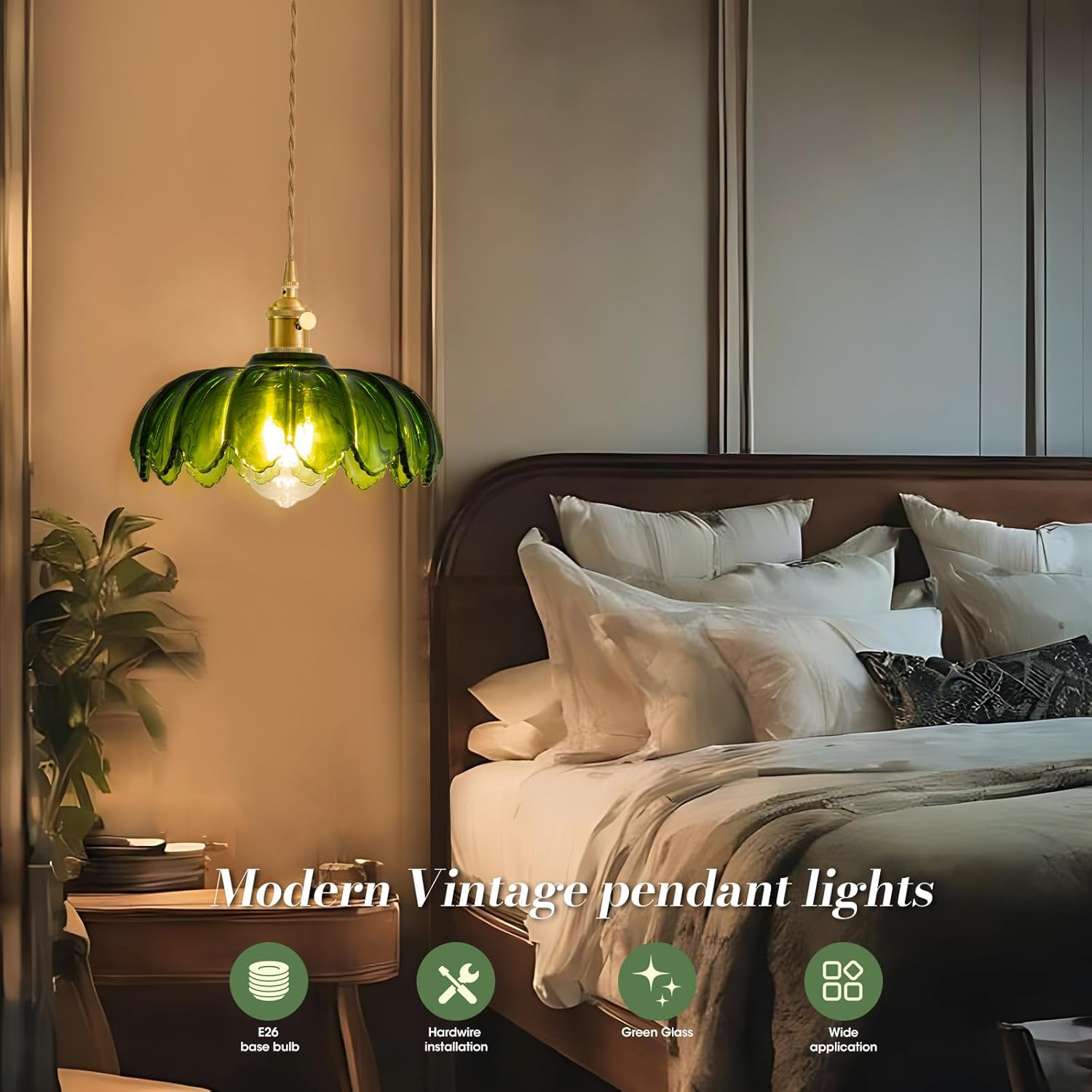
You found a pendant in a shade of sage green so good it felt like a decision, not a search — and then the second-guessing started. Will the color read muddy once it’s installed? Does ribbed glass (glass with parallel ridges pressed or blown into its surface, which scatter light differently than smooth glass) behave differently than a plain-walled globe? And what exactly separates “honey amber” from “cognac” from “tobacco” in a product description that uses all three words for what looks like the same hue?
Colored glass pendants sit at a tricky intersection: they carry more visual weight than clear or white glass, which means the stakes for getting the details right — glass type, light source color temperature, finish pairing, room context — are higher. This guide works through the practical decision tree for green and amber specifically, because those two families dominate the current colored-glass market and have meaningfully different behaviors. After comparing specs across 50+ fixtures and reading owner reviews aggregated on Houzz, Lumens, and YLighting, here’s what the pattern shows.
| EDITOR'S PICK[BOKT Vintage Brushed Brass Semi…](https://www.amazon.com/dp/B0DC3NWLT8?tag=greenflower20-20) | Mid-tier[XZHGCEE Pendant Lights Kitchen…](https://www.amazon.com/dp/B0DY5FYCRS?tag=greenflower20-20) | Budget pick[XZHGCEE Hanging Lamp Plug in Pe…](https://www.amazon.com/dp/B0CZLQJ262?tag=greenflower20-20) | |
|---|---|---|---|
| Glass Color | Amber | Amber | Green |
| Mount Type | Semi-flush | Pendant | Pendant plug-in |
| Bulb Base | — | E26 | E26 |
| Bulb Included | — | — | No Bulb |
| Material | Brass + Glass | Glass | Glass |
| Dimensions (W) | 9.8" | — | — |
| Price | $75.99 | $40.60 | $37.99 |
| See on Amazon → | See on Amazon → | See on Amazon → |
The Core Tradeoff: Colored Glass Filters Light, It Doesn’t Just Tint It
This is the single most underappreciated fact about colored pendants, and it’s where a lot of installs go wrong.
Clear glass transmits roughly 90% of a bulb’s lumen output. Depending on saturation and glass thickness, a green or amber pendant can transmit anywhere from 40% to 75% of that same output. The fixture you’re specifying for a kitchen island that needs task-level brightness will underperform if you’re pulling a globe diameter and wattage number without accounting for glass color.
By the numbers — approximate lumen transmission by glass type (manufacturer-rated averages across surveyed fixtures):
| Glass Color / Type | Approximate Lumen Transmission |
|---|---|
| Clear, smooth | 88–92% |
| Seeded clear (small air bubbles in glass) | 75–82% |
| Honey amber, thin-walled | 60–72% |
| Deep amber / tobacco, thick-walled | 40–55% |
| Sage green, ribbed | 52–65% |
| Forest / emerald green, opaline-tinted | 38–50% |
The practical implication: if you’re replacing a clear pendant with an amber or deep green one at the same socket, you should expect to step up your bulb’s lumen rating to compensate — or accept that the fixture is now purely atmospheric rather than task-functional. Neither answer is wrong, but it needs to be a deliberate call.
Apartment Therapy’s 2024 piece on amber glass lighting noted that the trend’s staying power is partly because warm amber “turns any bulb into candlelight” — which is accurate and flattering for dining rooms, but actively problematic over a prep surface where you need to see what you’re cutting.
Green Glass: Ribbed Sage vs. Mouth-Blown Emerald — Choosing the Right Expression
Green is the more complex of the two color families because it spans a wide emotional range. Sage (a muted, grayish green) reads as quiet and organic. Emerald or forest green reads as saturated and formal. Olive reads as earthy and warm. They are not interchangeable in a space, and they’re not manufactured the same way.
Ribbed sage — the version you see most often in the $120–$400 mid-market pendant — is almost always machine-pressed. Machine-pressed glass (shaped by mechanical molds rather than a glassblower’s breath and tools) produces consistent wall thickness and uniform rib geometry. That consistency is a feature in high-volume production: every unit looks the same on an island with three pendants. The tradeoff is that machine-pressed ribbed glass has a flatter, more graphically regular light scatter. Dwell Magazine’s 2024 piece on hand-blown vs. machine-made glass notes that mouth-blown pieces carry “micro-variations in wall thickness that create a living quality to the light” — the kind of subtle animation that makes a single pendant feel intentional rather than catalog-sourced.
For designers speccing green pendants in the $600–$2,500 range (Rejuvenation, Visual Comfort, Roll & Hill), the mouth-blown distinction matters. Rejuvenation’s mouth-blown globe pendants in their sage colorway show visible gather marks — slight thickening where the glassblower’s tool met the molten form — that scatter light in organic pools rather than uniform rings. Owner reviews on Lumens for comparable Visual Comfort pieces consistently describe this as “warmth you can’t get from a regular fixture.” That’s not marketing language; it’s the actual optical physics of non-uniform glass wall thickness at work.
Decision frame for green:
- Three matching pendants over a kitchen island → machine-pressed ribbed sage is the rational call. Consistency matters more than character; the $150–$250 price point per unit is defensible.
- Single statement pendant over a dining table or in an entryway → mouth-blown, ideally with visible texture (seeded, gathered, or lightly ribbed by hand). Budget $400–$900+ per unit. The light scatter justifies the premium.
- High-saturation emerald or forest green → confirm the glass type before ordering. Deeply pigmented green glass manufactured thin enough to transmit meaningful light is technically harder to produce; mouth-blown pieces from studios tend to have better color clarity than machine-pressed pieces at comparable saturation. Architectural Digest’s 2025 coverage of colored glass interiors specifically called out studio-blown emerald pendants from American makers as achieving “depth without muddiness” — a distinction that comes down to the glass batch formulation, not just the blowing technique.
Amber Glass: Honey vs. Tobacco, and Why Bulb Temperature Is the Hidden Variable
Amber glass behaves differently from green in one crucial way: its warmth is additive with the bulb’s color temperature rather than contrasting against it. This creates a compounding effect that can go either direction.
Color temperature (measured in Kelvins, or K — lower numbers are warmer/more orange, higher numbers are cooler/more blue-white) is the variable most buyers under-specify when ordering amber pendants. Here’s the practical matrix:
- 2200K bulb + honey amber glass: Very warm, candlelit, almost amber-on-amber. Ideal for dining rooms and bedrooms. Becomes orange-cast rather than golden in some thick-walled pieces — read owner reviews before committing.
- 2700K bulb + honey amber glass: The sweet spot for most installations. Warm white light filtered through amber reads as rich gold rather than orange. This is the combination Houzz community reviewers most consistently rate as “exactly what I imagined” in their amber pendant posts (per Houzz’s 2025 colored glass discussion threads).
- 3000K bulb + honey amber glass: Cleaner, less romantic. The cooler white source cancels some of amber’s warmth. Works in kitchens where you want amber’s aesthetic without losing too much functional brightness.
- 2700K bulb + deep tobacco/cognac glass: This combination can read as dim and murky unless the fixture diameter is large (12”+ globe) or the bulb’s lumen output is high (800+ lumens). Deep amber glass at small diameters with moderate-lumen bulbs is the most common cause of “I love the look but it’s too dark” reviews.
The finish pairing tradeoff is where amber and green diverge sharply. Amber glass is broadly forgiving of warm metal finishes — unlacquered brass (brass left without a protective coating, which ages to a mellow patina over months), aged brass, and warm bronze all read as natural companions because they share the amber’s warmth family. Blackened steel or matte black hardware creates a deliberate contrast that Architectural Digest’s 2025 colored glass feature described as “the combination that made colored glass feel contemporary rather than nostalgic.”
Green glass is more demanding. Sage and olive greens pair best with unlacquered brass (the warmth softens the green’s coolness) or with matte black (which reads as graphic and intentional). Chrome or polished nickel hardware against green glass tends to feel unresolved — the cool metal and the organic color fight each other without a clear winner. This is a pattern that comes up repeatedly in Houzz owner photo reviews for green pendant fixtures: unlacquered brass canopies and stems consistently receive the “this is exactly right” comments; chrome versions of the same fixture in the same green glass get “something feels off” responses, even when reviewers can’t articulate why.
Seeded Glass, Opaline, and the Terms You Need to Decode Product Listings
Colored glass pendants layer color terminology over glass-type terminology, and listings routinely conflate them. Here’s the working vocabulary:
Seeded glass refers to air bubbles intentionally introduced into the glass batch during production. Seeding is independent of color — you can have seeded clear, seeded amber, or seeded green. The bubbles scatter light omni-directionally and add depth that reads as handcrafted even in machine-made pieces. Seeded amber is one of the most forgiving combinations for buyers who want warmth without full commitment to deep color saturation.
Opaline glass is glass with a milky, semi-opaque quality — not fully transparent, not fully opaque. Opaline is not the same as milk glass (which is fully opaque and white). An opaline green pendant will read as softer and more diffused than a transparent green globe; it reduces glare from the bulb but also reduces the colored-light-cast effect on surrounding surfaces. If you want green light to “paint” the ceiling or wall, opaline green will do less of that than transparent green. If you want a soft green glow without visible bulb hotspot, opaline is the better call.
Ribbed glass describes surface texture, not color. Ribbing can be applied to any color. The visual effect of ribbing on colored glass is to multiply the light refraction points — colored ribbed glass casts more complex light patterns than smooth colored glass of the same hue, particularly when dimmed.
This Old House’s 2025 dimmer guide notes that decorative glass pendants should be paired with trailing-edge (LED-compatible) dimmers rather than older leading-edge models to avoid flicker — a detail that becomes more visible through colored glass than through clear, because the tinted surface amplifies any light instability.
The Decision Rules
If you’re standing at the specification decision right now, here’s the compressed framework:
If the pendant is over a task surface (kitchen island, reading zone): Choose honey amber or ribbed sage over deep tobacco or forest green. Confirm lumen transmission specs. Run a 2700K bulb. Size up the globe diameter if the space allows.
If the pendant is purely atmospheric (dining, entry, bedroom): Deep amber and emerald green are viable. A single mouth-blown piece at $400–$900 outperforms three machine-pressed pieces at $150 each in terms of light quality and design intention.
If finish pairing is undecided: Default to unlacquered brass with either color family. It ages into both green and amber without ever fighting them. Blackened steel is the correct alternative for spaces where you want the colored glass to read as modern rather than artisanal.
If the listing uses “amber,” “cognac,” “honey,” and “tobacco” interchangeably: Ask the retailer for the glass transmission spec or a lit photo before ordering. These are meaningfully different saturations with different lumen outputs. The ambiguity in product copy is a known issue across the mid-market category, and a reputable retailer (Lumens, YLighting, Rejuvenation) will have a lighting specialist who can pull the relevant data.
Colored glass done right is one of the few fixture categories where a single pendant can shift a room’s atmosphere as effectively as a paint color. The work is in reading the specs honestly — and knowing which variables to weight before the fixture ships.