June 26, 2026 • Odalys Ferreira • 9 min reading time • Prices verified June 18, 2026
Glass Pendant Lights Under $100 for Renters: What Actually Looks Expensive and What Gives Itself Away
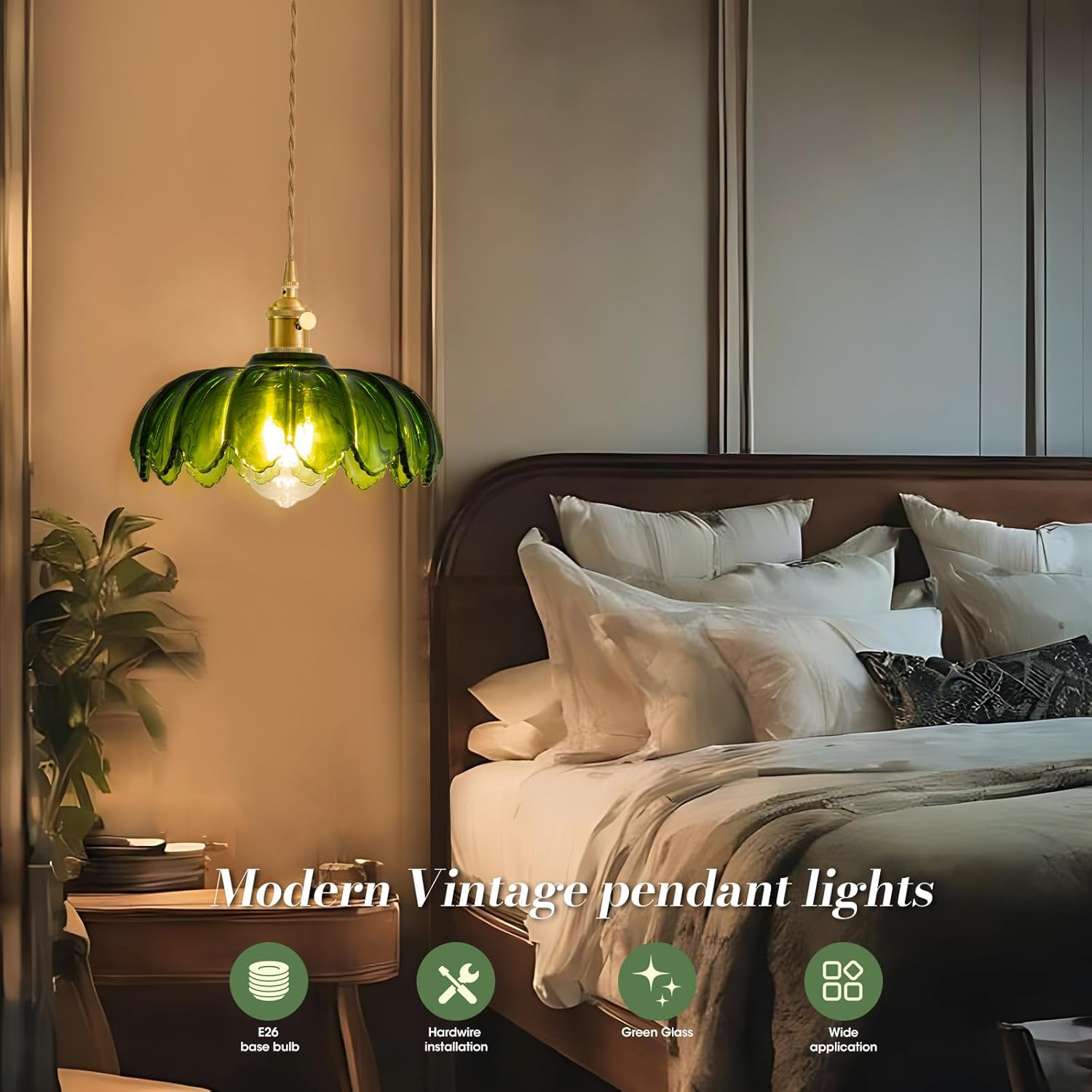
You found a glass pendant on sale for $68 and it looks exactly like the $340 one from Rejuvenation in the thumbnail. So: is it? Almost certainly not — but “not the same” and “gives itself away immediately” are two very different failure modes, and most renters never learn to tell them apart until after the fixture is hanging. A glass pendant is simply a light fixture where the shade or globe (the part that surrounds the bulb) is made from glass rather than fabric, metal, or plastic. At the under-$100 price point, you’re working with machine-pressed glass — glass shaped by automated molds — rather than mouth-blown glass, which is shaped by a glassblower’s breath and hands and costs significantly more. The visual difference between those two processes is real, but it’s not always decisive. This article walks through exactly what separates a budget pendant that reads as intentional and design-forward from one that reads as a placeholder — so you can make a confident call on your current rental refresh without overspending or being disappointed.
The Variables That Actually Determine “Does This Look Cheap?”
Before you compare fixtures, it helps to isolate which properties your eye is actually responding to when it decides something looks expensive. In the glass pendant world at this price tier, four variables do most of the work.
Glass clarity and color cast. Machine-pressed glass is inherently more uniform than mouth-blown glass — which sounds like a compliment but often isn’t. The uniformity can produce a flat, almost plastic-looking surface, especially in clear glass globes. What elevates a budget clear-glass pendant is slight variation: seeded glass (glass with intentional tiny air bubbles suspended through it, created during the pressing process) introduces enough visual texture that the machine origin becomes less obvious. Reviewers on Houzz consistently note that seeded-glass pendants in the $70–$95 range photograph and read in-person far closer to studio-blown pieces than their smooth clear counterparts at similar prices. If you’re choosing between a smooth clear globe at $65 and a seeded-glass version at $85, the seeded glass is almost always the better spend.
The canopy and cord. The canopy is the small ceiling plate that covers the electrical box — the hardware most buyers ignore until it’s hanging on their ceiling. At the sub-$100 tier, canopies are almost always stamped metal, which is fine. What gives them away is finish inconsistency: a brushed nickel canopy with a slightly blueish or plasticky sheen, or a “brass” canopy that’s clearly a thin yellow coating over chrome. Apartment Therapy’s coverage of renter-friendly lighting upgrades specifically flags canopy finish as the detail most likely to undermine an otherwise solid fixture. The cord or stem material matters too — a fabric-wrapped cord reads better than a plain white or black plastic cord in nearly every interior context.
Shade geometry and wall thickness. Thicker glass walls catch and refract light differently than thin-walled glass. Budget pendants frequently use thinner glass to reduce material cost; the result is a shade that glows brighter and more uniformly, losing the subtle depth and warmth that a thicker wall produces. You won’t always find wall thickness in product listings, but you can infer it: if the product photos show a bright, even glow with no visible variation across the surface, the glass is probably thin. If you see subtle shadow gradients or the glass looks slightly milky toward the base, that’s usually a thicker, better-performing piece.
Bulb visibility and color temperature. A pendant shade that’s designed to partially conceal the bulb (a cage pendant with a recessed socket, or an opaque lower shade) is more forgiving of whatever bulb is inside. A clear glass globe is brutally honest — it puts the bulb on display, and the wrong bulb will define the whole reading of the fixture. The standard recommendation from lighting design resources, including guidance published by the Lighting Design Lab, is 2700K for clear and seeded glass in residential settings; it produces a warm, slightly amber glow that reads as intentional. A 5000K daylight bulb in a clear glass globe reads as a construction light. This is a free correction and one of the highest-leverage moves in rental lighting.
What the $60–$100 Market Actually Looks Like Right Now
As of mid-2026, the sub-$100 glass pendant category has stratified more than it had even two years ago. The bottom of the range ($35–$60) is dominated by smooth clear or amber globes with plastic canopies and unbranded cord sets — these are the fixtures that give the whole tier a bad reputation. The $70–$100 band has gotten meaningfully better, largely because mid-market brands have started using seeded and ribbed glass (glass with parallel ridges pressed into the surface, which creates visual interest similar to the texture in vintage industrial fixtures) as standard rather than premium options.
By the numbers:
| Price band | Typical glass type | Canopy finish quality | Cord treatment |
|---|---|---|---|
| $35–$60 | Smooth clear or amber, machine-pressed | Stamped metal, thin coating | Plain plastic |
| $70–$85 | Seeded or ribbed, machine-pressed | Stamped metal, improved finish | Fabric-wrapped common |
| $86–$100 | Seeded, opaline, or textured | Cast or weighted metal | Fabric-wrapped standard |
Opaline glass — a white or off-white glass with a soft, milky translucency — appears more frequently at the $86–$100 tier and performs particularly well in rental contexts because it diffuses light broadly (reducing harsh shadows) and reads as classic rather than trend-driven. Dwell Magazine’s coverage of budget-friendly glass fixtures has noted opaline globes as a consistent overperformer in terms of perceived quality relative to price.
The Tradeoffs You’re Actually Making
This is where the decision framing gets useful. At this price point, you are always trading something. Here’s the honest map.
Seeded glass vs. smooth clear: Seeded glass wins on visual texture and disguises the machine-pressed origin. It loses in spaces where you want maximum light output — the bubbles diffuse light slightly, reducing effective lumens. For a kitchen island over a light-colored counter, that’s a negligible tradeoff. For a dark reading nook, it’s worth knowing.
Globe shape vs. cylinder/schoolhouse shape: Open-bottom globes (the classic round shape, open at the bottom where the socket hangs) are the most common and the most forgiving of budget construction because the eye is drawn to the overall silhouette. Cylinder pendants and schoolhouse shades expose the rim edge, where budget glass often shows uneven thickness or a slightly rough cut. Architectural Digest’s pendant buying guides consistently note rim finish as a quality tell — if you’re choosing a schoolhouse or cylinder at this price, read reviews specifically for comments about the rim edge.
Single pendant vs. a cluster of three: One of the most effective ways to make a budget pendant feel intentional is to use a cluster of three on a multi-cord canopy over a dining table or island. The aggregate effect reads as a considered design decision rather than a placeholder. The tradeoff is installation complexity — a multi-cord ceiling canopy requires three junction points and correct spacing, which is more involved than a single swap. This Old House’s pendant installation guide notes that multi-pendant canopies should be treated as a small project, not a plug-and-play swap, especially in rentals where you’ll need to restore the original fixture cleanly on move-out.
Unlacquered brass vs. brushed nickel canopy: At this price tier, unlacquered brass — brass with no protective coating, which develops a natural patina over time — is essentially unavailable. What’s sold as “brass” is usually lacquered brass or brass-toned zinc. That’s not a dealbreaker, but it does mean the finish won’t age gracefully the way a premium fixture does; it will eventually chip or dull in a less organic way. Brushed nickel, by contrast, is a finish that budget manufacturers handle more consistently, and it tends to hold up better in rental conditions. If the hardware isn’t a feature you want to highlight, brushed nickel at this price point is the lower-risk choice.
The Signals That Give a Budget Pendant Away
Across aggregated owner reviews on Houzz and retailer review sections, a consistent pattern emerges around what actually causes buyers to regret a budget glass pendant purchase. It’s rarely the glass itself.
The canopy sits visibly away from the ceiling. A canopy that doesn’t lie flat against the ceiling box — because it’s slightly undersized or the mounting hardware is imprecise — is a hard-to-ignore tell. Read product reviews specifically for this; it comes up frequently in the $55–$75 range.
The cord color doesn’t match the canopy. A black fabric cord with a brushed nickel canopy, or a white cord with a bronze fixture, is an internal inconsistency that reads as an assembly decision rather than a design one. Check product photos carefully.
The glass color shifts under incandescent vs. LED light. Some budget glass has a slight green or blue cast that’s invisible under warm incandescent light but visible under the cooler spectrum of some LED bulbs. If you’re committed to a specific LED and the listing doesn’t show that bulb type in the product photography, look for owner photos rather than studio photos in the reviews.
The socket is visible at an awkward angle. On open-bottom globes, the socket and bulb are part of the composition. A socket that rides too high in the globe, or sits at an angle, looks like a quality control miss. This is mentioned frequently in reviews of pendants in the $60–$75 range and is worth filtering for.
The Decision Rule
If the fixture will hang at or below eye level in a space you occupy regularly — kitchen island, dining table, reading corner — invest the extra $15–$25 to reach the $85–$100 band and prioritize seeded or opaline glass with a fabric-wrapped cord. The perceptual return on that incremental spend is disproportionate.
If it’s a secondary space or a fixture that hangs high (entryway, stairwell), a smooth-glass globe at $60–$70 with a brushed nickel canopy and a 2700K LED bulb will do the work without visual apology — and you can put the savings toward a better bulb or a dimmer switch, both of which will do more for the room’s atmosphere than the last $25 of fixture cost.
The honest ceiling of this tier is “looks considered and intentional.” The honest floor is “reads as placeholder.” Everything in this guide is aimed at keeping you firmly on the right side of that line.