May 17, 2026 • Odalys Ferreira • 12 min reading time • Prices verified June 18, 2026
Clear Glass Globe Pendants Head-to-Head: Organic Blown, Hammered, and Seeded Side by Side
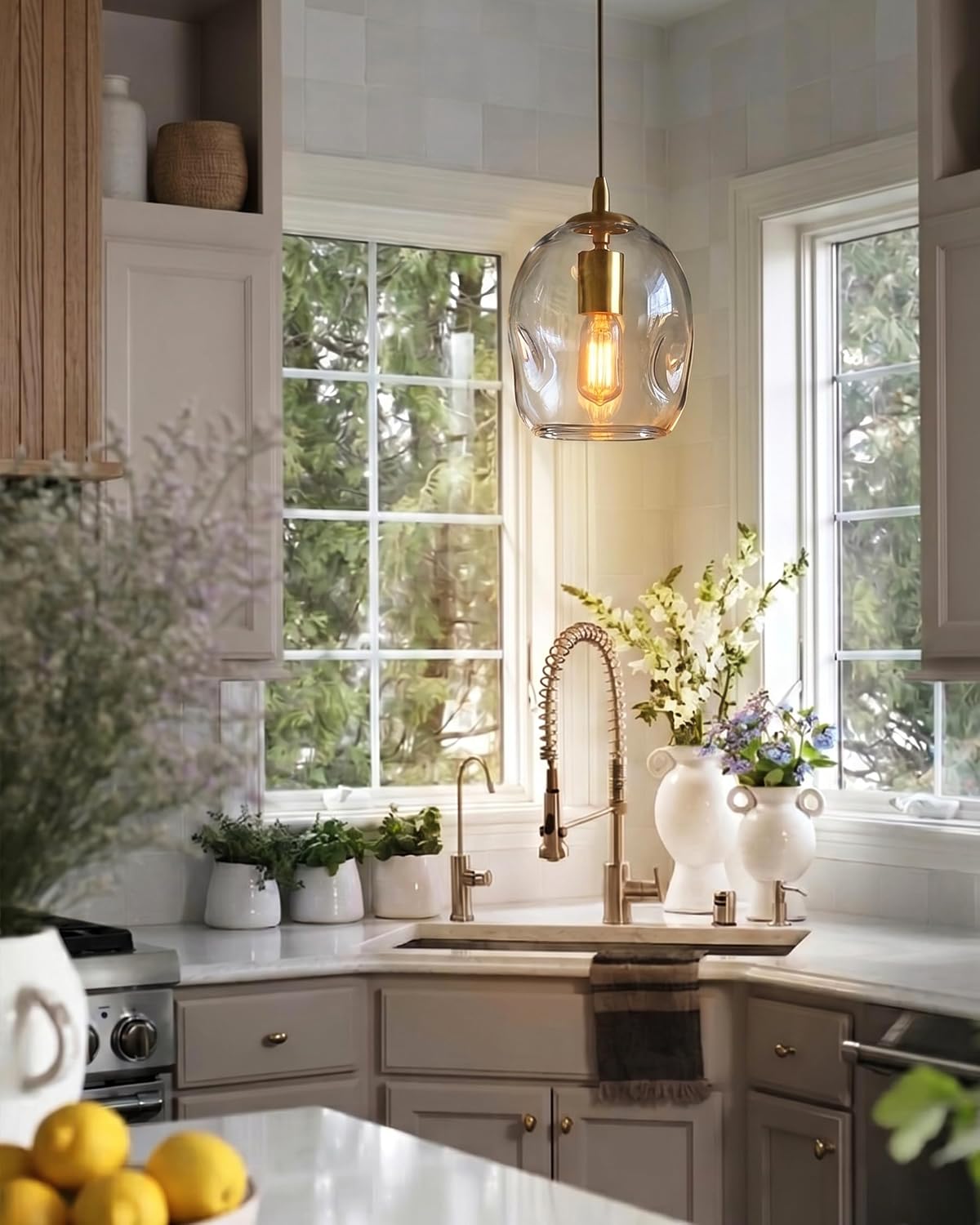
You found the pendant you love — but now you’re staring at three listings that all say “clear glass globe” and wondering why one is $38, one is $85, and one is $140, and whether any of them will actually look the way you’re picturing them in your kitchen. Here’s what’s actually different: the forming technique used to shape the glass. Organic hand-blown glass (shaped by a glassblower’s breath and gravity, producing gentle asymmetry and ripple) behaves completely differently from hammered glass (mechanically or hand-textured with a dimpled surface that fragments and reflects light) and seeded glass (glass with tiny trapped air bubbles that soften the bulb’s glow into a warm haze). Each technique produces a distinct transparency level, ceiling pattern, and ambient mood. After comparing specs across 40-plus globe pendants and reading through hundreds of owner reviews, here’s what we found — and a clear decision rule at the end so you can stop second-guessing.
The Core Tradeoff: Transparency vs. Pattern vs. Diffusion
Every choice between these three glass types is essentially a vote on one of three lighting priorities:
- Organic blown glass → maximum transparency with gentle character. The glass reads as “almost clear” but with subtle movement. Light passes through with very little scattering.
- Hammered glass → dramatic pattern projection. Light hits the faceted surface and throws sparkle across ceilings and walls. Lower transparency than blown, but the texture is the point.
- Seeded glass → gentle diffusion with visual warmth. The air bubbles scatter light softly, hiding the bulb’s hot spot and producing even, ambient glow. Least transparent of the three.
If you’re lighting a task zone (kitchen island, reading nook) and want the fixture to also read as a sculptural object from across the room, organic blown or hammered gets you there. If you want flattering, even light with a cozy period aesthetic, seeded is the right call.
Organic Hand-Blown Glass Pendants
Budget Tier: Entry-Level Organic Blown Clear Globe
Entry-level organic blown clear globe pendants in the six-to-eight-inch range typically fall in the $35–$55 range and are widely available through home improvement retailers. Owner feedback in this category follows a consistent pattern: buyers are surprised by how much character the slight irregularity adds without reading as rustic or handmade-in-a-distracting-way. The glass transmits a very high proportion of lumen output precisely because it is close to fully transparent.
One transparency issue worth flagging explicitly at this tier: color variants — particularly blue and amber — consistently read significantly deeper and richer in person than product listing images suggest. If you’re ordering a color variant for a specific palette match, treat listing images as approximate. The clear versions appear consistent with photography, but color variants at the budget tier carry real uncertainty. That is a buy-risk worth knowing before you commit to a multi-pack.
CASAMOTION
$72.50
In stock on Amazon
Check price on AmazonMid-Tier: Organic Blown Globe with Brass Canopy, 8–10 Inch
Mid-tier organic blown pendants in the $70–$95 range pair the same near-clear transparency with more considered hardware — typically a solid brass or brushed-gold canopy and a textile-wrapped cord. Owner-review language in this category is notably strong: the phrase “the most-complimented item in my home” appears as a genuine recurring observation, not a coached superlative, suggesting these fixtures function as conversation anchors in a way that most pendants do not.
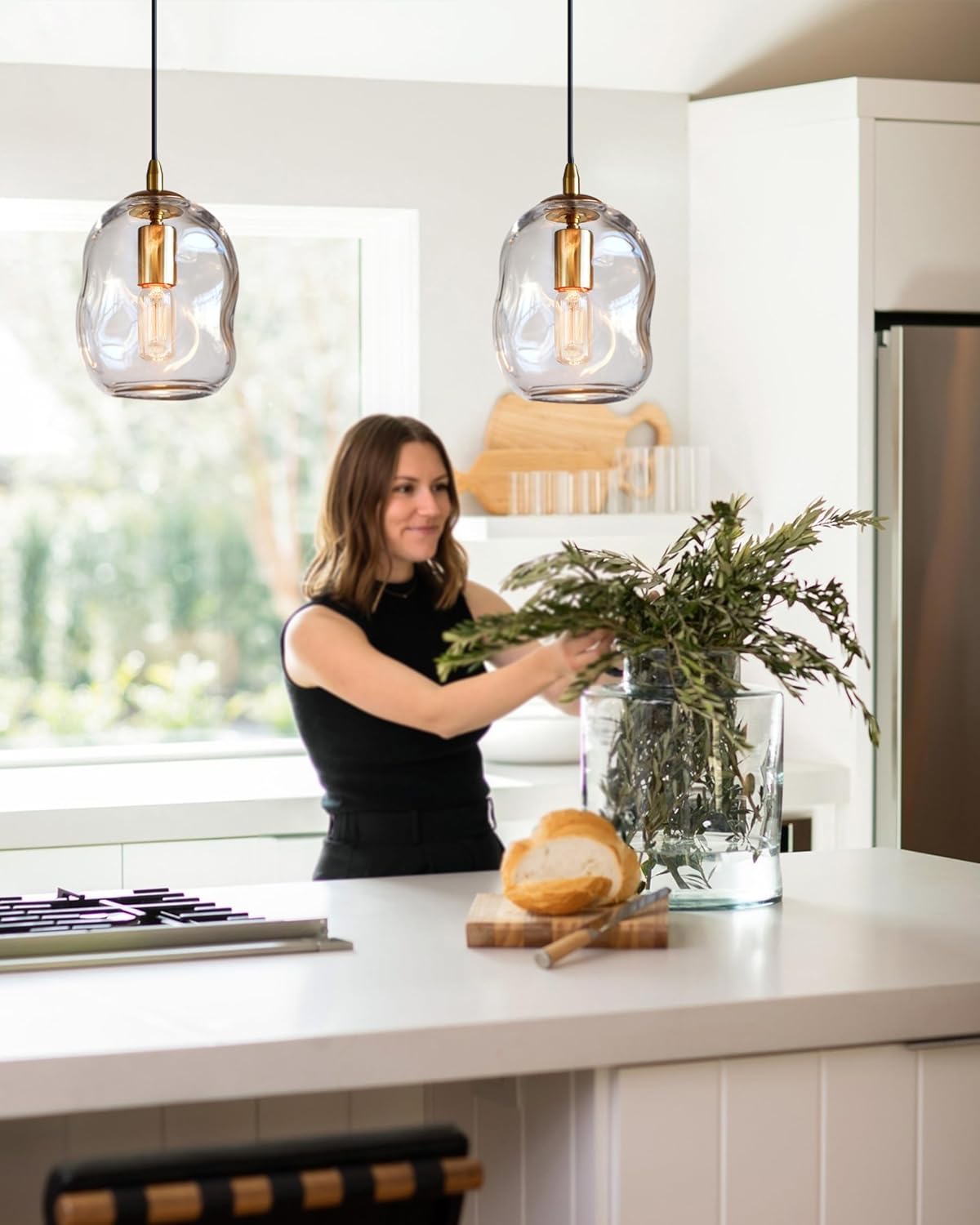
The design logic holds up. Organic blown glass has a slight irregularity — a gentle ovalizing, a soft ripple at the equator — that reads as handmade without being rustic. It works in a 1920s Craftsman bungalow and a 2022 white-oak-and-quartz kitchen without visual conflict. That aesthetic versatility is uncommon at any price point.
On light output: because organic blown glass is close to fully transparent, it transmits a very high percentage of the bulb’s lumen output. Architectural Digest’s pendant lighting guide notes that clear and near-clear glass shades typically transmit 85–95 percent of lumen output, compared to 50–70 percent for moderately textured glass. If you’re using these over a work surface, you’re getting functional task light. The bulb shape will be visible, so bulb selection matters aesthetically: a classic globe (G25) or tubular filament reads well; a standard A19 looks slightly utilitarian inside an organic globe.
The view-through advantage: one reviewer observation that genuinely surprised us — buyers of clear globe brass pendants in this tier specifically note that the clear glass doesn’t block the sightline to a water feature or garden view outside a window. Organic blown glass at mid-tier makes that claim more credibly than seeded or hammered glass at any price. If your pendant will hang in a window zone or near a view you want to preserve, the transparency calculus tilts hard toward clear blown glass.
 product image](/images/external/d18f46d64db7.jpg)
Brushed
$90.53
In stock on Amazon
Check price on AmazonPremium Tier: Organic Blown Statement Globe, 12–14 Inch
At the premium tier ($120–$160), organic blown globes scale up to 12–14 inches and are designed to anchor a full kitchen or dining room rather than punctuate it. Reviewers at this scale describe committing to a full hardware refresh — converting existing cabinet pulls and faucet hardware to match the fixture’s brass or aged-brass finish — because the pendant’s presence makes mismatched metals visible in a way a smaller fixture does not.
A 14-inch globe pendant at standard 30-inch drop height over an island will dominate a kitchen under 200 square feet. In a large open-plan kitchen or a dining room with 10-foot ceilings, it earns that scale. In a galley or smaller eat-in kitchen, a cluster of six-to-eight-inch pendants in any of these three glass types will read more balanced than a single large-format globe.
CASAMOTION
$139.50
In stock on Amazon
Check price on AmazonHammered Glass Pendants: The Pattern-Projection Specialist
Budget Tier: Hammered Clear Globe, Single or 2-Pack, 6–8 Inch
If organic blown glass is about transparency with quiet character, hammered glass is about activating the room. Budget-tier hammered clear globe pendants — most commonly sold in two-packs in the $55–$80 range — generate specific, detailed owner praise around one phenomenon: the sparkle pattern thrown onto ceilings. Owners of two-pack hammered pendants specifically note how light bounces across an eight-foot island ceiling, which reframes these fixtures as task lighting that also functions as ambient scene-setting. That dual role is valuable when you’re designing a kitchen that needs to work for prep and for dinner parties.
CASAMOTION
$72.50
In stock on Amazon
Check price on AmazonMid-Tier: Hammered Globe with Adjustable Cord, Brass or Black Finish
Mid-tier hammered pendants in the $85–$110 range add longer adjustable cords, more considered canopy finishes, and slightly thicker glass walls that improve the shimmer quality. Owner accounts at this tier are particularly useful for buyers: reviewers describe experimenting with Edison-style filament bulbs versus standard LED A19 bulbs to control the pattern’s intensity. The finding: Edison-style filament bulbs (with their warm, point-source glow) produce sharper, more defined sparkle patterns; LED A19 bulbs with a diffused emitter produce softer, more wash-like scatter. That is a genuine insight for anyone who wants to tune the effect.
Per the IES Residential Lighting Handbook, highly textured glass surfaces like hammered glass amplify the color of the light source more dramatically than smooth glass — warm 2700K filament bulbs produce amber-gold sparkle patterns; cool 4000K LEDs produce a crisper, bluer sparkle. For most residential kitchens, 2700K is the right starting point unless you have a strongly contemporary, cool-palette space.
What hammered glass gives up: transparency. The faceted surface makes the fixture feel more opaque at rest (when unlit), which reads more substantial and decorative — but it also means you lose the view-through clarity of organic blown glass. If your installation is window-adjacent or above a feature you want to see through, hammered is the wrong call.
Brushed
$90.53
In stock on Amazon
Check price on AmazonPremium Tier: Hammered Globe, Large Format, Matte Black or Aged Brass
Large-format hammered globe pendants at the premium tier ($120–$175) produce the most dramatic ceiling patterns of any glass type at any scale. Reviewers at this tier frequently describe the fixture’s light-off silhouette as the secondary reason they bought it — the texture reads as intentional and architectural even when the pendant is unlit.
Finish pairing matters significantly at this scale. Houzz’s kitchen island lighting guide notes that blackened-steel and matte-black canopies pair particularly strongly with hammered glass because the contrast between dark metal and bright sparkle pattern is most visually dramatic. Brushed gold or satin brass canopies echo the angular light play of the faceted surface and work well in warmer-palette kitchens.
CASAMOTION
$139.50
In stock on Amazon
Check price on AmazonSeeded Glass Pendants: The Warm Diffuser
Budget Tier: Lightly Seeded Globe, 6–8 Inch, Brushed Nickel or Chrome Finish
Seeded glass — clear glass with intentionally trapped air bubbles — is the period-authentic choice. Apartment Therapy’s comparison of seeded versus ribbed versus clear glass pendants notes that bubble density directly controls how much of the bulb’s filament is visible: lightly seeded glass (fewer, smaller bubbles) lets you see the bulb clearly; heavily seeded glass hides it almost completely and produces a soft, lantern-like glow.
Budget-tier lightly seeded globes in brushed nickel or chrome ($35–$60) are the most accessible entry point into seeded glass and work well in bathrooms, entryways, and kitchens where you want a hint of period character without strong visual weight.
CASAMOTION
$72.50
In stock on Amazon
Check price on AmazonMid-Tier: Heavily Seeded Globe, Brass Canopy, 8–10 Inch
For buyers working in a kitchen or dining room where the pendant hangs at or near eye level, heavily seeded glass offers a real comfort advantage — no visible hot spot, no glare. Houzz’s kitchen island lighting guide specifically flags glare from clear-glass pendants as a common complaint when the fixture hangs at seated eye level; seeded glass solves that problem without sacrificing period warmth.
Mid-tier heavily seeded pendants in the $75–$100 range with aged-brass or unlacquered-brass canopies are the natural choice for Shaker, transitional, or farmhouse kitchens. Architectural Digest’s pendant lighting guide notes that warm-toned glass — including amber-adjacent seeded glass when lit — pairs most naturally with unlacquered and aged brass fixtures, which develop a patina that echoes the organic quality of the bubbled glass.
The tradeoff: seeded glass is categorically not a view-through material, and it is the most conservative choice aesthetically — it reads period-correct and traditional in a way that organic blown glass does not. If your kitchen is strongly contemporary or Scandinavian-influenced, seeded glass can feel slightly mismatched.
Brushed
$90.53
In stock on Amazon
Check price on AmazonPremium Tier: Statement Seeded Globe, 12–14 Inch, Antique Brass
Premium seeded globes at 12–14 inches and $130–$165 are designed for dining rooms, high-ceilinged entryways, and open-plan kitchens where a single large fixture reads more cohesively than a cluster. At this scale, the diffusion quality of seeded glass is particularly valuable: a heavily seeded 14-inch globe produces a lantern-like glow that reads warm and dimensional from across a large room in a way that a clear or hammered globe of the same size does not.
CASAMOTION
$139.50
In stock on Amazon
Check price on AmazonBy the Numbers: Glass Type vs. Key Performance Variables
| Glass Type | Lumen Transmission | Ceiling Pattern | Bulb Visibility | Best Bulb Type |
|---|---|---|---|---|
| Organic hand-blown | High (~85–95%) | Minimal | High | Globe or tubular filament |
| Hammered clear | Moderate (~60–75%) | Strong sparkle | Moderate | Edison filament (2700K) |
| Seeded/bubbled | Moderate-low (~50–65%) | Soft scatter | Low | Any; bulb hides well |
(Lumen transmission ranges are approximate, drawn from the IES Residential Lighting Handbook guidance on glass texture and transmission. Individual fixtures will vary.)
Frequently Asked Questions
What is the difference between hand-blown organic glass and hammered glass in terms of light output? Organic blown glass is close to fully transparent and transmits the highest proportion of lumen output — roughly 85–95 percent by IES estimates. Hammered glass, with its faceted surface, transmits somewhat less (60–75 percent range) but redirects and scatters light more dynamically, producing stronger ceiling and wall patterns. If raw task-lighting output is the priority, organic blown wins. If ambient atmosphere is the goal, hammered is more interesting.
Does hammered glass create patterns on the ceiling and walls? Yes — this is the defining characteristic. Owners of hammered pendants specifically describe the sparkle pattern as the fixture’s most discussed feature. The pattern intensity is controlled by bulb type: point-source filament bulbs (Edison style) produce sharper, more defined patterns; diffused LED emitters produce softer scatter.
Which clear glass pendant finish pairs best with existing brass hardware? If your existing hardware is warm brass or unlacquered brass, organic blown glass or seeded glass in a brass or aged-brass canopy will feel most cohesive. If your hardware is brushed gold or satin brass, hammered glass with a gold or brass fixture cap reads well. Black-finished pendants are finish-agnostic and work with any glass type.
Are these pendants dimmable, and which bulb type works best? Most pendants in this category accept standard E26 base bulbs, which means dimmer compatibility is determined by the bulb, not the fixture. LED bulbs rated for dimming work with standard trailing-edge dimmers. For hammered glass specifically, owners report that filament-style LED bulbs produce the best sparkle pattern. This Old House’s pendant lighting installation guide recommends verifying dimmer compatibility with the bulb manufacturer before purchasing a dimmer switch.
How heavy are hand-blown glass pendants, and will my existing junction box support them? Organic blown glass pendants in the six-to-ten-inch range typically weigh two to five pounds complete with canopy and cord — well within the 35-pound rating of a standard fan-rated junction box. Larger 12–14-inch blown glass pendants can reach six to eight pounds. This Old House’s pendant lighting installation guide recommends upgrading to a fan-rated box for any pendant exceeding five pounds; verify your junction box rating before installation.
Can I mix organic and hammered glass pendants in the same kitchen? Mixing is possible but requires intentional design logic. The most successful mixed installations use a consistent finish (all brass, all black) and consistent size to create cohesion while the glass texture varies. Mixing organic blown and hammered glass at different scales, or with different finish temperatures, tends to read as accidental rather than deliberate.
The Decision Rule
If you’re still undecided, here’s the if/then frame:
- If your priority is transparency — you want to see through the fixture, preserve a view, or maximize task-light output — choose organic blown glass in clear (avoid color variants unless you’ve confirmed the shade in person).
- If your priority is atmosphere and pattern — you want the fixture to animate the ceiling and create sparkle at dinner — choose hammered glass and pair it with an Edison-style filament LED at 2700K.
- If your priority is glare control and period warmth — the pendant hangs near eye level, you want soft diffuse light, or your kitchen aesthetic is traditional — choose seeded glass.
All three types work at a kitchen island. The right answer is the one that matches what you’re actually trying the light to do — not just how it looks in the listing photo.